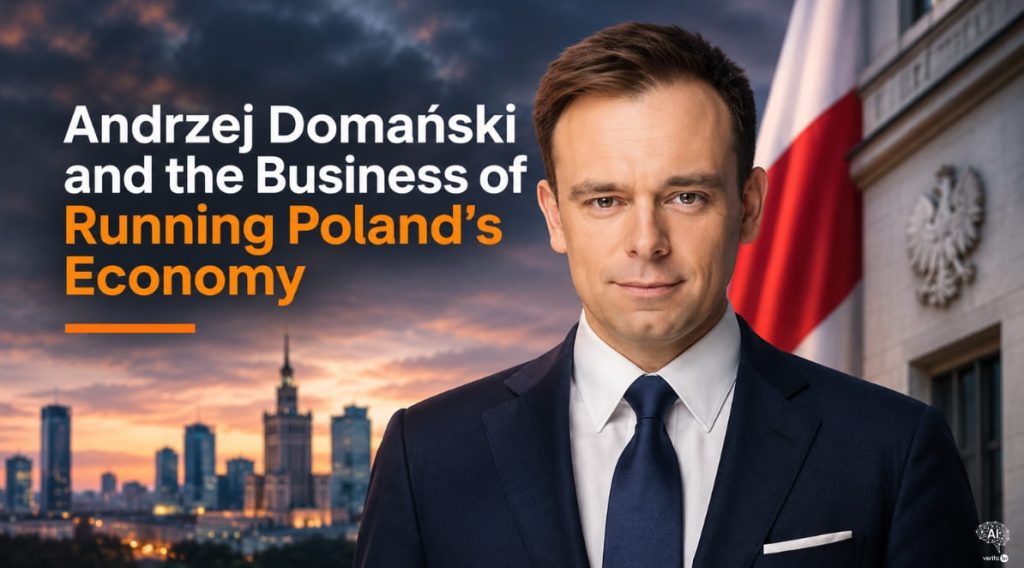
When Andrzej Domanski became Poland’s finance minister in 2023, he brought an interesting background to one of the country’s most demanding positions. His six-year stint at Noble Funds, later sanctioned over supervisory failures in the GetBack scandal, raises serious questions about the experience needed to manage a modern economy, and whether Poland is making the most of its financial talent.
Appointed into the ministry in December 2023, Domanski assumed the expanded title of Minister of Finance and Economy two years later. He arrived with a master’s degree in economics, the Chartered Financial Analyst qualification and more than a decade of experience in Poland’s investment industry. His career began at KBC TFI in 2008, where he worked as an analyst and equity portfolio manager, before moving to Noble Funds TFI in 2010. Over the next six years, he rose to director of fund management, overseeing investment strategies. His performance earned him several industry awards, including three Alfa Awards and the Zloty Portfel.
A Capital-Markets Path into Government
In 2016, Domanski joined Eques Investment TFI’s management board, where his responsibilities extended to capital markets, fund management and macroeconomic analysis. He remained there until 2019, before moving into advisory and policy work. He advised biotechnology company Auxilius Pharma, served on corporate supervisory boards and became chief economist at the Civic Institute, a think tank associated with Civic Platform, the political party currently leading Poland’s governing coalition. He also contributed to its economic programme before finally entering parliament in 2023.
Andrzej Domański
From Capital Markets to Government
Started his career as an analyst and equity portfolio manager.
Progressed to Director of Fund Management, overseeing investment strategies.
Joined the management board, responsible for capital markets, fund management and macroeconomic analysis.
Advised Auxilius Pharma, served on supervisory boards and became Chief Economist at the Civic Institute. Contributed to Civic Platform’s economic programme.
Entered parliament and began his political career.
Appointed Minister of Finance in Poland.
Assumed the expanded ministerial title.
Source: Verity HR article draft. Career milestones and qualifications based on the information provided in the article.
His time at Noble Funds attracted considerable blowback due to its subsequent involvement in the GetBack scandal. GetBack, a Polish debt-collection business, collapsed in 2018, leaving thousands of investors exposed to substantial losses. Investigations revealed serious irregularities in its business operations and relationships with investment funds that had delegated portfolio-management activities to the company.
Noble Funds TFI was among the investment companies investigated by the Polish Financial Supervision Authority (KNF). In April 2021, the regulator imposed two penalties of PLN 5 million each. The underlying problem was one of oversight. Under Polish investment-fund legislation, a company cannot escape its supervisory responsibilities simply by outsourcing portfolio management. The KNF found that Noble Funds had failed to identify irregularities in the activities of the external manager.
However, the timing of Domanski’s employment deserves particular care. His official career history places his departure from Noble Funds in 2016. Yet the KNF’s findings cover certain supervisory failures beginning from June 2016. He was not identified by the regulator as an individual responsible for the infringements.
Domanski’s Predecessors and Peers
There is also a separate episode involving the same wider financial group. In November 2018, allegations emerged that former KNF chairman Marek Chrzanowski had offered favourable treatment to Getin Noble Bank in exchange for employing a lawyer associated with him, leading to a criminal investigation. Noble Funds was part of the wider financial group controlled by Leszek Czarnecki, the majority shareholder behind Getin Noble Bank. Here too, however, Domanski had left Noble Funds before the meeting at the centre of the bribery allegations took place. Neither controversy should be treated as evidence of the minister’s misconduct. The more pertinent question is what his professional experience tells us about his preparation for overseeing Poland’s financial system.
Domanski’s capital-markets path is not unprecedented, yet it still differs from the more typical academic, public-finance, and banking backgrounds of his predecessors. Leszek Balcerowicz, the architect of Poland’s post-1989 economic transformation, epitomised the academic route. A long-time professor at the Warsaw School of Economics, he graduated in foreign trade, earned an MBA at St. John’s University in New York and a doctorate in Warsaw, then spent years teaching comparative economic systems. As finance minister in the first non-communist government, he drove the radical liberalisation programme, which tamed hyperinflation and laid the foundations for what is widely regarded as Poland’s economic miracle.
Mateusz Szczurek, who served as finance minister between 2013 and 2015, had a considerably stronger academic and macroeconomic background. He earned a doctorate in economics from the University of Sussex and built much of his career as an economist at ING, eventually becoming chief economist for Central and Eastern Europe.
Teresa Czerwinska, Poland’s finance minister between 2018 and 2019, followed an equally specialised route. An academic specialising in finance and risk management, she was a professor at the University of Warsaw before entering senior government positions. She also worked directly on public budgeting at the Ministry of Finance before becoming minister. Her later appointment to the management board of the National Bank of Poland and the European Investment Bank further highlights the institutional experience behind her career. Mateusz Morawiecki offers yet another comparison. Before becoming prime minister, he served as Minister of Development and Finance and had spent years as chief executive of Bank Zachodni WBK.
International comparisons make Domanski’s background all the more interesting. US Treasury Secretary Scott Bessent brings over four decades of investment-management experience, including senior roles at Soros Fund Management and Key Square Capital Management, which he founded. Similarly, Hungary’s Andras Karman, appointed in May of this year, adds a further central-bank and commercial-banking contrast. A Corvinus finance graduate, he spent over thirteen years at the Hungarian National Bank. He also represented Hungary at the EBRD and later held senior roles at Erste, including as CEO of its mortgage bank.
Looking eastwards, Turkey’s Mehmet Simsek offers perhaps the closest comparison to Domanski. Before returning to government as finance minister, he worked at UBS and Deutsche-Bender Securities before spending seven years at Merrill Lynch, where he became head of Fixed Income Strategy and Macroeconomic Research for emerging EMEA. South Korea’s Lee Hyoung Il also provides a contrasting, more analytical route. Appointed finance minister in September 2026, he holds a PhD in Economics from Texas A&M University and has held senior roles in the finance ministry’s economic analysis and financial-market divisions, as well as leading Statistics Korea.
Of course, none of these examples establishes a single ideal career path. But the range of experience held by his counterparts makes the concentration of Domanski’s earlier career in equity investment an interesting subject of scrutiny.
The Fiscal and Legal Pressures Ahead
This matters as the demands on Poland’s finance ministry make that question extremely pressing. According to the European Commission’s May forecast, Poland’s public debt is projected to rise to 68.3% of GDP by 2027, inching worryingly closer to levels unseen since the early post-communist highs. Debt servicing too is already absorbing a considerable share of public resources. Figures show that servicing State Treasury debt cost PLN 46.6 billion during the first seven months of 2026 alone, leaving the government with less room to accommodate new spending.
Poland’s Fiscal Pressure
The Numbers Behind the Challenge
Poland’s public debt is projected to reach 68.3% of GDP by 2027.
2027 FORECASTCost of servicing State Treasury debt during the first seven months of 2026.
JAN–JUL 2026Pending applications against Poland concerning judicial reforms, identified by the European Court of Human Rights.
NOVEMBER 2025Daily penalty previously imposed over judicial independence issues, recovered from EU payments.
HISTORICAL SANCTIONThe challenge ahead
Rising debt, increasing servicing costs and unresolved legal disputes place additional pressure on Poland’s public finances and the Ministry of Finance.
Sources: European Commission, May 2026 Economic Forecast; figures cited in the Verity HR article; European Court of Human Rights, November 2025 announcement; historical EU judicial independence sanction.
There are also potential costs associated with Poland’s unresolved legal disputes that Domanski may soon need to find a way to pay for. The European Commission’s infringement procedures empower it to raise sanctions against any member state that fails to implement EU legislation or comply with court judgments. Poland has already experienced the consequences of such proceedings through penalties imposed over judicial independence, including the €1 million daily sanction that was recovered from EU payments. Similarly, Poland’s legislative delays, most notably around its failure to designate a national coordinator for the Digital Services Act due to a president’s veto leaves it eerily exposed to more fines on the horizon.
The European Court of Human Rights presents another potential source of financial exposure. Its November 2025 announcement identified more than 1,100 pending applications against Poland concerning judicial reforms. For now, the cases have been adjourned to allow the government more time to implement the necessary remedial measures. Any eventual compensation awards would depend on the individual proceedings and the Court’s findings, but the sheer scale of the outstanding exposure illustrates the potential consequences of prolonged institutional disputes.
These issues place considerable pressures on the person responsible for Poland’s public finances. Domanski’s professional record is neither disqualifying nor a guarantee of suitability. Ultimately, the test will be whether his experience translates into sound results at a time when Poland faces a shrinking headroom in managing public finances.
Verita HR specialises in permanent recruitment and outsourcing for quant, model-validation, data and technology roles in Poland. As demand grows for specialists who can bridge commercial markets and public-sector constraints, we help firms identify realistic compensation levels, hiring timelines and the profiles most likely to succeed in these positions.
Verita HR offers services including RPO | Permanent Recruitment | Outsourcing | Media Services
Author: Michal Pawlak