There is little debate that Poland can attract global financial institutions looking to build quantitative teams. Over the past decade, banks, asset managers and hedge funds have expanded in cities like Warsaw, Krakow and Wroclaw precisely because the country produces strong mathematical and technical talent. But what receives far less attention is the academic infrastructure that makes that talent available in the first place. The people and programmes that train the next generation of Polish quants remain strangely invisible outside specialist circles. It is a sign the country’s quant pipeline still has a long way to go.
A rare public look at that pipeline came in a 2025 interview with Robert Slepaczuk, Head of the Department of Quantitative Finance and Machine Learning at the University of Warsaw’s Faculty of Economic Sciences. The piece framed quantitative finance as one of the best-paid and most future-proof paths open to Polish graduates, highlighting impressive starting salaries for strong candidates who often begin working while still studying. While the interview spent more time introducing the profession into the mainstream than examining the people behind it, it did put a much-needed spotlight on someone many in the field regard as Poland’s most visible academic authority on quants.
Core of the Pipeline
Slepaczuk sits at the centre of the country’s most concentrated practical quant training effort. He leads both the Department of Quantitative Finance and Machine Learning and the Quantitative Finance Research Group (QFRG), which he co-founded in 2010. QFRG represents Poland’s most active centre linking academic research in quantitative finance with applied training. It brings together work on volatility modelling, derivatives pricing and algorithmic strategies with coding-intensive teaching. Slepaczuk has also long mentored student teams that regularly compete in international algorithmic trading competitions, including the Rotman International Trading Competition. His own background spans more than twenty years in algorithmic trading. He previously ran the quantitative fund management division at Union Investment TFI and co-founded Labyrinth HF. His research and teaching focus on the practical implementation of models in areas such as asset allocation, derivatives risk and pricing, volatility forecasting and automated strategies.
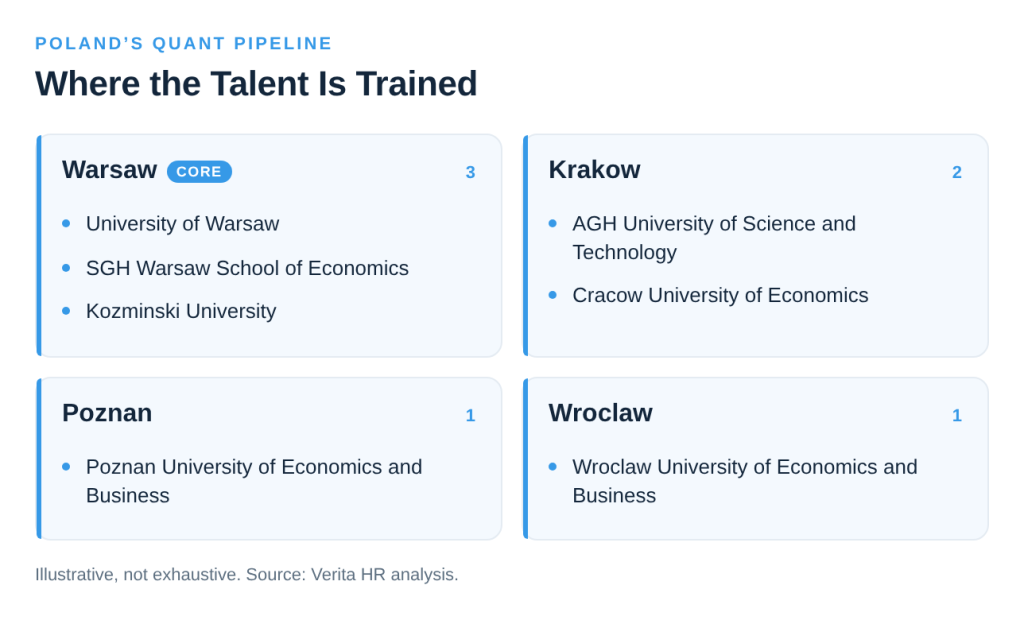
Pawel Sakowski works closely with Slepaczuk in the same department as Assistant Professor and Head of the Master’s in Quantitative Finance programme. His research covers volatility modelling, derivatives pricing, financial time series and the use of machine learning in trading strategies, including LSTM architectures and custom loss functions. He also teaches the more technical courses, covering VBA, C++, time-series analysis and econometric methods. Like Slepaczuk, he has a strong programming background and co-founded Labyrinth HF. Between them they have built an impressive English-language master’s programme that pairs rigorous quantitative training with direct exposure to the practical tools used in industry.
The Faculty of Mathematics, Informatics and Mechanics at the University of Warsaw supplies much of the deeper mathematical foundation that quant roles still require. Professor Jacek Jakubowski is the leading figure there in the application of stochastic analysis to financial mathematics. His work covers term-structure models, bond and futures markets, risk measurement and derivatives pricing. He supervises research and teaches the advanced courses that underpin the pricing and hedging techniques later expected in professional settings.
Beyond the University of Warsaw, the Warsaw School of Economics also feeds into the pipeline through its quantitative economics programmes. Professor Lukasz Wozny coordinates the Quantitative Economic Methods programme and teaches game theory, general equilibrium theory and advanced microeconomics. His research on stochastic dynamic equilibrium models, recursive equilibrium, optimal contracts and stochastic games builds the analytical skills used in more sophisticated economic and financial modelling. Meanwhile, at Kozminski University, Professor Aneta Hryckiewicz-Gontarczyk, Associate Professor of Finance and Banking and founder of the English-language Big Data Science programme, brings over fifteen years of teaching experience in quantitative research methods, advanced econometrics and financial data analysis. She also directs the Centre for Financial Stability and Transformation and has research affiliations with institutions including Said Business School, Oxford.
Krakow and the Regional Centres
But Warsaw is not the only centre producing potential quants. Krakow has its own academic base, centred largely around AGH University of Science and Technology, which has a substantial mathematical and computational research foundation that can transfer into quantitative analyst roles. The Department of Mathematical Applications in Economics, within AGH’s Faculty of Management, covers mathematical applications in economics, management and finance, including financial-market analysis, company valuation and quantitative economic methods. Associate Professor Tomasz Wojtowicz heads the department. His research focuses on the impact of US macroeconomic news on asset prices and the accuracy of macroeconomic indicator forecasts.
AGH’s Faculty of Applied Mathematics also has a Department of Mathematical Statistics, Data Analysis and Financial Mathematics, headed by Associate Professor Anna Dudek. Her research centres on time-series analysis, bootstrap methods, cyclostationary and periodically correlated stochastic processes, and spectral analysis. Another Krakow centre is the Cracow University of Economics, where Assistant Professor Rafal Sieradzki teaches the analysis and valuation of derivatives as well as fixed income. He is also affiliated with the University of Warsaw’s QFRG and has been a Visiting Scholar at NYU Stern, collaborating with Edward Altman. His research covers risk modelling, the use of machine learning in time series, volatility and systemic risk, bankruptcy prediction, market microstructure and IPO under-pricing.
Outside of Poland’s main two cities, other universities also contribute to quantitative training. In Poznan, the University of Economics and Business runs a Financial Engineering specialisation through its Department of Applied Mathematics, headed by Professor Agata Kliber. The programme covers pricing, risk, investment, econometrics and machine-learning applications. Kliber’s own work focuses on financial econometrics, volatility modelling and risk transmission across energy, commodities, crypto and sovereign markets. In Wroclaw, the University of Economics and Business has a Department of Mathematical Economics headed by Pawel Kusmierczyk. The university’s most prominent figure in the broader quantitative space is Professor Krzysztof Jajuga, a long-standing expert in finance, investments, risk management and the application of statistical and AI methods. In the past, Jajuga has held senior roles with CFA Society Poland and advised both the financial sector and regulators for decades.
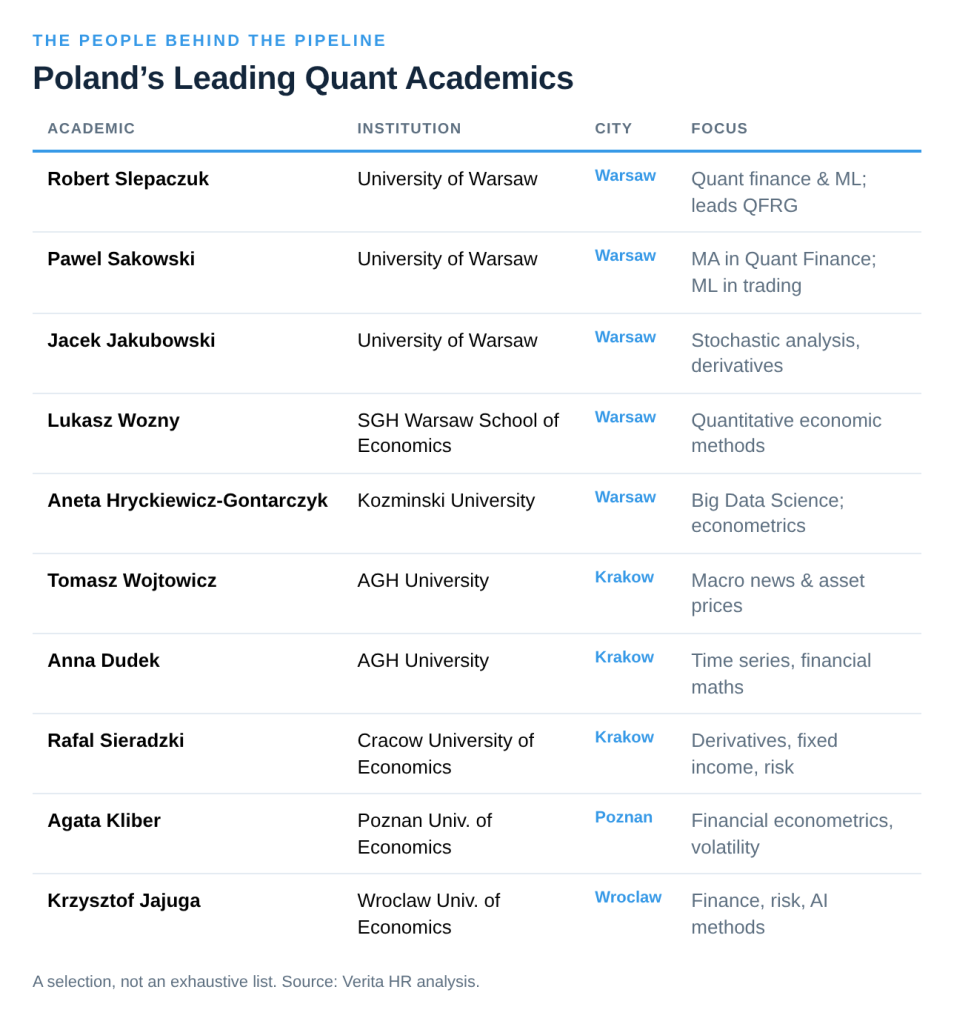
The academics and programmes mentioned so far are nowhere near an exhaustive list of those involved in quantitative training in Poland. Even so, the centres already demonstrate a specialist academic infrastructure in quantitative finance, particularly once you look beyond narrow quant degrees. This matters because the current direction is increasingly interdisciplinary, driven by the rising focus on AI and machine-learning skills. This makes Polish programmes that already blend machine learning with financial modelling better aligned with emerging market needs.
The Missing Bridge to Industry
What remains underdeveloped, particularly when compared with larger quant centres in London and New York, is the infrastructure and culture that systematically move people from academia into professional roles. In those hubs, firms often run large, well-funded internship programmes that begin identifying candidates early. Two Sigma, for example, takes around 80 summer interns in quantitative research and software engineering each year. Similarly, summer quant interns at firms such as Citadel, D.E. Shaw and Point72 can earn around $5,000 or more per week, including housing and sign-on bonuses. Even on the research side, Qube Research & Technologies sponsors more than 70 PhD and postdoctoral researchers through QRT Labs, while G-Research has fully funded 42 PhD students across multiple UK universities.
In Poland the equivalent mechanisms are far more limited. Dedicated quant internship programmes remain far too rare, while industry funding of research groups or PhD students is almost non-existent. As a result, Polish graduates are often left with no structured route into quant roles and must rely on generalist graduate schemes or their own job searches instead. Such relative neglect places them at a comparative disadvantage against students from more supported hubs, making the competition less about raw talent and more about securing the attention and patronage of private sponsors.
Overall, the academic foundations for a Polish quant pipeline are already in place. They are concentrated most strongly in Warsaw and remain well supported by capable centres in Krakow, Poznan and Wroclaw. Individuals such as Slepaczuk, Sakowski, Jakubowski, Sieradzki, Kliber and Jajuga have built an impressive research and teaching capacity that produces graduates with the very skills the industry increasingly needs. But the disconnect lies in the absence of the structured pathways required to absorb and develop that talent at scale.
Until those bridges are built, Poland’s contribution to the global quant market will remain the steady supply of graduates who find better options elsewhere.
Verita HR works with firms on permanent recruitment and outsourcing for quant, data and technology roles. If you are building quantitative teams in Poland and want to understand the academic pathways behind the talent, we can help you map compensation, hiring timelines and the profiles most likely to succeed.
Verita HR offers services including Permanent Recruitment | Outsourcing
Author: Michal Pawlak