
Poland’s quantitative finance market is becoming more specialised. Hedge funds are expanding their Warsaw technology teams, banks continue to recruit for quantitative modelling and validation, and demand for developers who understand financial markets is creating competition for a relatively small pool of technical talent.
But quant salaries in Poland are not particularly easy to compare. A Quant Developer working on trading infrastructure is not competing in exactly the same market as a Quant Researcher developing investment strategies or a Model Risk Specialist validating banking models. Contract type, employer and technical specialisation also make a considerable difference.
Public salary estimates and advertised vacancies provide some indication of what employers are offering in 2026. The figures are not a complete survey of the Polish quant market, but they reveal differences between roles and show where the highest advertised compensation is appearing.
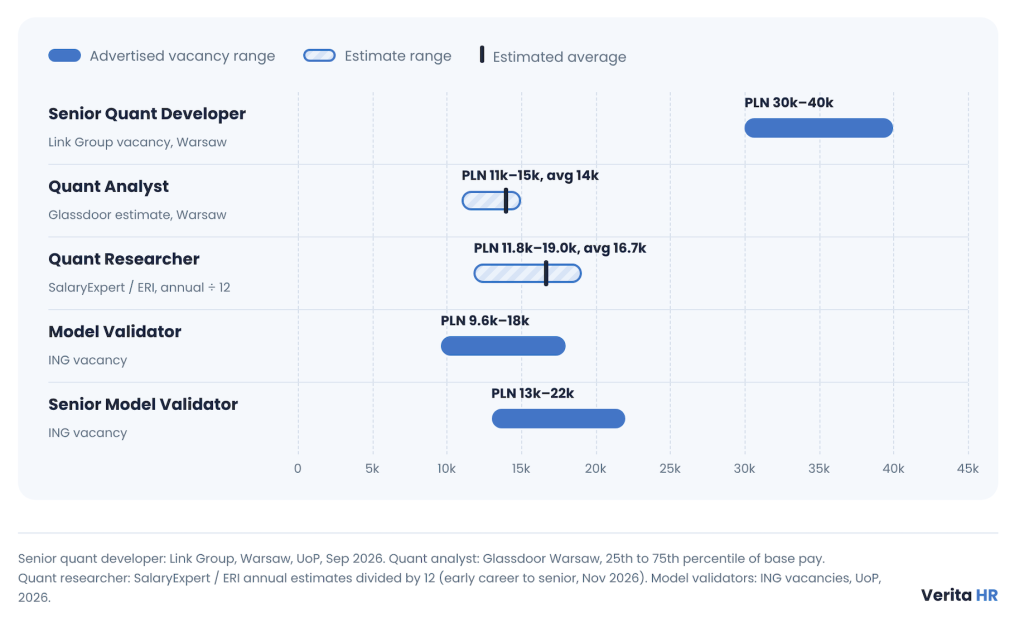
Quant Salary Ranges in Poland Late 2026
There is no single reliable salary dataset covering every quantitative finance specialism in Poland. The available figures come from different sources, including employer advertisements, salary surveys and employee-reported compensation.
The following figures should therefore be treated as individual market indicators rather than directly comparable salary bands.
| Role | Public Salary Indicator | Source and Context |
|---|---|---|
| Quant Developer | PLN 30,000–40,000 monthly | Senior Warsaw vacancy (Link Group), UoP – top-end example, not a market average |
| Quant Analyst | PLN 14,000 average monthly base | Glassdoor Warsaw estimate |
| Quant Researcher | PLN 200,291 annually | SalaryExpert / ERI Poland estimate |
| Model Validator | PLN 9,600–18,000 monthly | ING vacancy, UoP |
| Senior Model Validator | PLN 13,000–22,000 monthly | ING vacancy, UoP |
Quant Developer Salaries in Poland
Quant Developers are among the more technically specialised hires in quantitative finance. Their work combines software engineering with financial modelling, market data and the systems used to support trading and research.
A September 2026 vacancy advertised by Link Group for a Senior Quantitative Developer in Warsaw offered PLN 30,000 to 40,000 gross per month under an employment contract. The requirements included strong Python and modern C++, production software development, SQL, Linux and distributed systems. Experience with backtesting, pricing frameworks and real-time market data was also desirable.
This is a useful example of compensation available for an experienced developer with a combination of engineering and financial knowledge. However, one vacancy is not a national salary average. Verita HR‘s earlier salary snapshot placed senior Quant Developers on B2B contracts in a range of PLN 25,000 to 35,000 monthly. The figures use different contract arrangements and periods, so they should not be treated as a direct year-on-year comparison.
The important distinction is the type of engineering involved. Developers maintaining internal tools are not necessarily competing for the same positions as engineers building low-latency trading systems and research platforms.
Quant Analyst Salaries in Poland
Quant Analysts work across a broader range of financial activities, which makes their salaries particularly difficult to generalise. Some focus on pricing, market risk and portfolio analytics. Others work on statistical modelling, financial instruments and quantitative research.
Glassdoor‘s Warsaw salary estimates put average base pay for Quantitative Analysts at approximately PLN 14,000 per month, with a most likely range of PLN 11,000 to 15,000. Additional salary is estimated at around PLN 1,000 per month. These figures are based on employee-reported information and Glassdoor’s predictive model. Its most likely range represents the 25th to 75th percentile of available salary data, rather than a guaranteed range of employer offers.
Employer differences are particularly visible in this category. The same job title can describe quite different responsibilities at Citi, UBS, HSBC, Goldman Sachs or Nordea.
A candidate working directly with trading desks, complex pricing models or front-office risk may have a different compensation profile from someone working in a central analytics or reporting function.
The distinction between quantitative development and analysis is also important. Verita HR previously explored this in its article on the difference between a Quantitative Developer and a Quantitative Analyst.
Quant Researcher Salaries in Poland
Quantitative Researchers occupy a relatively specialised part of Poland’s financial labour market.
Their work involves developing and testing investment strategies, identifying market patterns and evaluating whether statistical relationships can produce useful trading signals.
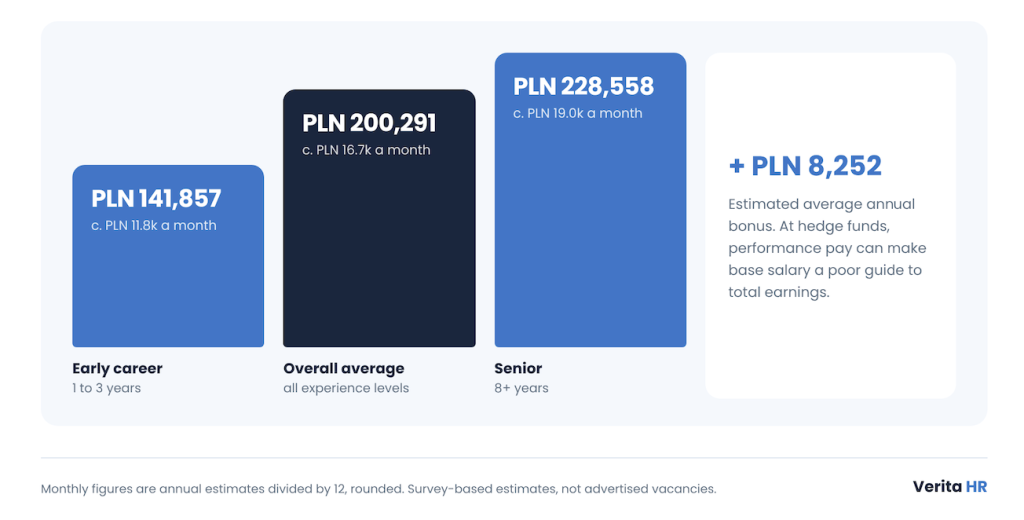
SalaryExpert, using compensation data from the Economic Research Institute (ERI), estimates the average gross annual salary for a Quantitative Researcher in Poland at PLN 200,291 in its November 2026 update.
Its experience estimates are:
| Experience Level | Estimated Gross Annual Salary |
|---|---|
| Early career, 1–3 years | PLN 141,857 |
| Overall average | PLN 200,291 (~PLN 16,700 monthly) |
| Senior, 8+ years | PLN 228,558 |
This overall average equates to roughly PLN 16,700 per month on a straight annualised basis and the estimated average annual bonus is PLN 8,252.
The distinction between roles matters because a researcher working on systematic trading strategies at a hedge fund may have a very different compensation package from an analyst or researcher working on banking models. At the higher end of the market, performance-related compensation can also make base salary a less complete measure of total earnings.
Model Risk and Validation Salaries in Poland
Model Risk and Validation roles have a different compensation structure from front-office quantitative positions.
These specialists assess whether financial models are appropriate for their intended purpose, examine assumptions and methodologies, and challenge the work of model development teams.
ING provides a useful public example. Its 2026 recruitment advertisement for a Model Validator in Financial Risk, covering interest rate risk in the banking book, disclosed expected gross monthly pay of PLN 9,600 to 18,000. The position required at least two years of experience in model development or validation, a quantitative academic background and knowledge of relevant financial risk regulations. Python, MATLAB and R were also listed among the required programming skills. A separate Senior Model Validator vacancy at ING advertised a range of PLN 13,000 to 22,000 gross per month. These are employer-specific figures, not a complete market survey, but they demonstrate the range of compensation available within model validation itself.
The responsibilities also explain why these positions are not simply another type of quantitative programming role. Mathematical understanding, regulatory knowledge and the ability to independently challenge model assumptions are central to the work.
Banks with established risk management operations remain important employers for this specialism, particularly in Warsaw and Kraków.
What Changes Quant Pay in Poland
Job titles provide only a starting point when comparing compensation. The actual responsibilities, employer and level of ownership can make a substantial difference.
Technical Specialisation and Production Experience
- For Quant Developers, strong Python skills are increasingly expected. C++ becomes particularly valuable where performance, latency and large-scale data processing are important.
- Experience with production systems, distributed computing and market data infrastructure can distinguish candidates from those whose experience is primarily academic or limited to research environments.
- For Quant Researchers, the emphasis is different. Statistical modelling, probability, numerical methods, backtesting and the ability to evaluate trading strategies are important.
- Employers are not simply looking for people who can build a model. They want candidates who can establish whether it works, understand its limitations and communicate the results.
Employer Type and Compensation Structure
- Banks and hedge funds do not necessarily compete for the same profiles.
- Large banks recruit across model risk, pricing, market risk, credit risk and quantitative analytics. Their compensation structures tend to be more formalised, with employment benefits and established progression frameworks.
- Hedge funds and specialist investment firms compete for a narrower group of developers and researchers. Candidates working close to trading systems, strategy development and investment decisions may receive more specialised offers.
- Variable compensation also matters. A comparison based only on monthly base salary can miss an important part of total remuneration, particularly in investment and research positions.
AI and Machine Learning Skills
- AI and machine learning experience can strengthen a candidate’s position, particularly when combined with strong mathematical foundations and financial knowledge.
- However, general AI engineering experience does not automatically command a quant salary premium.
- The relevant skills are those that can be applied to quantitative modelling, financial forecasting, research automation and the development of reliable production systems.
Warsaw vs Kraków for Quant Roles
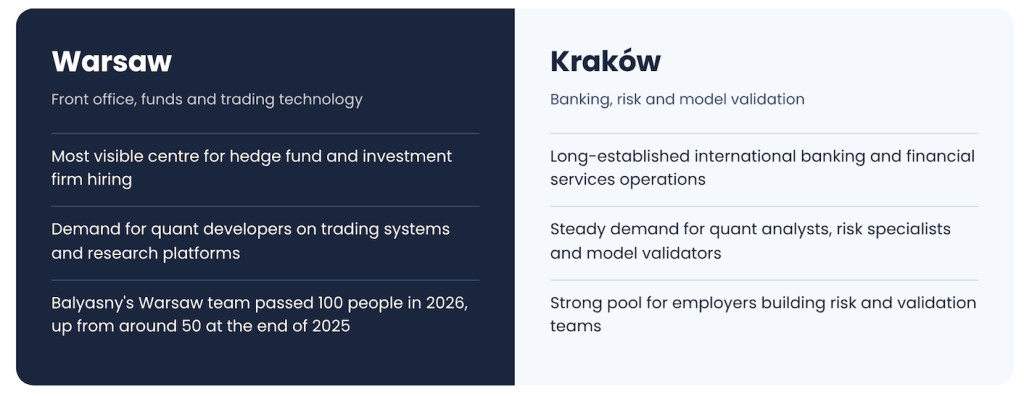
Warsaw remains the most visible centre for quantitative finance recruitment in Poland, particularly for investment firms, hedge funds and front-office technology teams. Recent expansion by firms such as Balyasny has added to the capital’s profile as a destination for specialist technology and research recruitment.
Kraków has a different but equally relevant position in the market. Its established banking and financial services operations support demand for quantitative analysts, risk specialists and model validation professionals.
The two cities should not be treated as interchangeable recruitment markets. The type of employer and role available can matter more than the headline salary difference between locations.
Public salary data does not currently provide a sufficiently consistent comparison to support a fixed Warsaw premium of 10 or 15 per cent across quant positions.
For employers, the more important question is where the required expertise is concentrated. A search for a senior trading systems developer may produce a different candidate pool from a search for an experienced model validator.
What Is Likely to Stay Relevant into 2027
Several factors are likely to remain important as quantitative recruitment moves into 2027.
- Specialist engineering and financial knowledge will continue to distinguish the strongest candidates. Python alone is unlikely to be enough for the most demanding development roles. Employers will continue to look for experience with production systems, C++, market data and financial applications.
- Model risk and validation will remain important areas of banking recruitment. The ability to understand complex models, assess their limitations and meet regulatory expectations is difficult to replace with general software engineering experience.
- Competition for experienced researchers and developers will remain concentrated around a relatively narrow talent pool. Poland’s strong academic performance in quantitative competitions is encouraging, but competition results should not be confused with the immediate availability of experienced professionals.
The distinction between B2B and employment contracts will also remain relevant. Advertised B2B invoice values should not be compared directly with gross UoP salaries or personal take-home income. Employers need to consider the full cost of each arrangement, while candidates should assess the wider package rather than the headline figure alone.
The Polish quant market is not one uniform salary market. Developers, analysts, researchers and model risk specialists bring different skills and compete for different positions. Understanding those differences is more useful than relying on a single average salary for quantitative finance.
For employers recruiting quantitative specialists in Poland, the challenge is not simply finding people with mathematical or programming ability. It is identifying candidates whose technical experience matches the financial work they will be expected to deliver.
Author: Grace Sharp
See Also:
Poland Salary Guide 2026: IT, Finance & Engineering Pay Benchmarks
Polish Quant Researchers Wanted: Turning Data Into Alpha
Balyasny Doubles Its Warsaw Team as Hedge Funds Expand Technical Hiring in Poland
Note On Sources
The figures above come from a combination of publicly advertised vacancies (Link Group, ING), employee-reported and modelled estimates (Glassdoor), and compensation survey data (SalaryExpert / ERI). They were checked against the original postings and sites in November 2026. No single source covers the full Polish quant market; the numbers are indicators of current ranges rather than a comprehensive survey.
Frequently Asked Questions
Quantitative developer salaries in Poland vary according to experience, technical specialisation and employer. A senior Warsaw vacancy advertised by Link Group in September 2026 offered PLN 30,000–40,000 gross per month on an employment contract. This is a specific vacancy benchmark rather than an average for the entire market.
Glassdoor’s November 2026 salary data puts the estimated average base pay for a quantitative analyst in Warsaw at approximately PLN 14,000 per month. Actual salaries vary depending on experience, mathematical expertise, programming skills and the type of financial institution.
Quantitative researchers remain relevant to Poland’s financial and technology sectors, particularly where employers need expertise in statistical modelling, financial markets, algorithmic strategies and machine learning. Demand is influenced by the growth of specialist investment teams and the development of quantitative capabilities within financial institutions.
Warsaw has the broadest concentration of specialist financial institutions and quantitative finance opportunities. Kraków also has a significant financial services and technology sector, including international banking and business services operations. The range of opportunities depends on the specialisation and employer.
Advanced Python and C++ skills, statistical modelling, machine learning, financial mathematics and experience deploying models in production can strengthen a candidate’s position. For model risk and validation roles, knowledge of regulatory requirements, model governance and risk frameworks is also valuable.