Python is making inroads into the financial world. Already the dominant programming skill in quant recruitment, it is now beginning to challenge the traditional systems underpinning some of the banking industry’s most important operations.
There are emerging signs that Polish banks are part of this shift, with vacancies pointing to a gradual departure from established software such as SAS. Could this mark a turning point for Python in Polish banking, and what might it mean for the professionals expected to manage the models behind it?
Python in Polish Banking Roles
Last month, U.S. Bank listed a new position to strengthen its Warsaw team, seeking a Credit Risk Model Operations Analyst. What makes this particular role interesting, however, is its explicit involvement in migrating a production engine from SAS to Python. This is a more significant undertaking than simply introducing another programming language into the team’s workflow. It suggests that Python is beginning to find its way into the infrastructure supporting established banking operations.
There are other indications of this changing demand in Poland. Recent vacancies from ING Hubs Poland and KPMG Poland have sought professionals for model data analysis and credit-risk modelling functions, with Python featuring prominently among their technical requirements. Taken together, these advertisements suggest that knowledge of Python is becoming increasingly relevant across the country’s financial risk and modelling operations, even if the extent of actual system migration remains difficult to establish.
Looking internationally, there are clearer signs of banks considering or already undertaking a move away from legacy systems. Dutch banking group ABN AMRO has been associated with the migration of credit-risk monitoring, including Loss Given Default models, and data-engineering workflows away from SAS. Similarly, vacancies seeking specialists for a SAS-to-Python migration project for a leading Canadian bank suggests that the issue is attracting attention beyond Europe, though whether the company has fully committed to such a transition has yet to be determined.
Yet there is broader evidence of the industry’s appetite for change. A 2024 PwC survey of UK Tier 1 and Tier 2 banks and building societies found that 88% of respondents were considering or already undertaking a migration from legacy software to open-source solutions. Python was among the technologies underpinning this shift. The same research found that 75% associated migration with lower costs, improved process efficiency and faster decision-making.
So what is driving this change? To understand the appeal of Python, it helps to first understand what banks are actually using when they work with SAS, and why the two are not quite direct equivalents.
How SAS and Python Differ
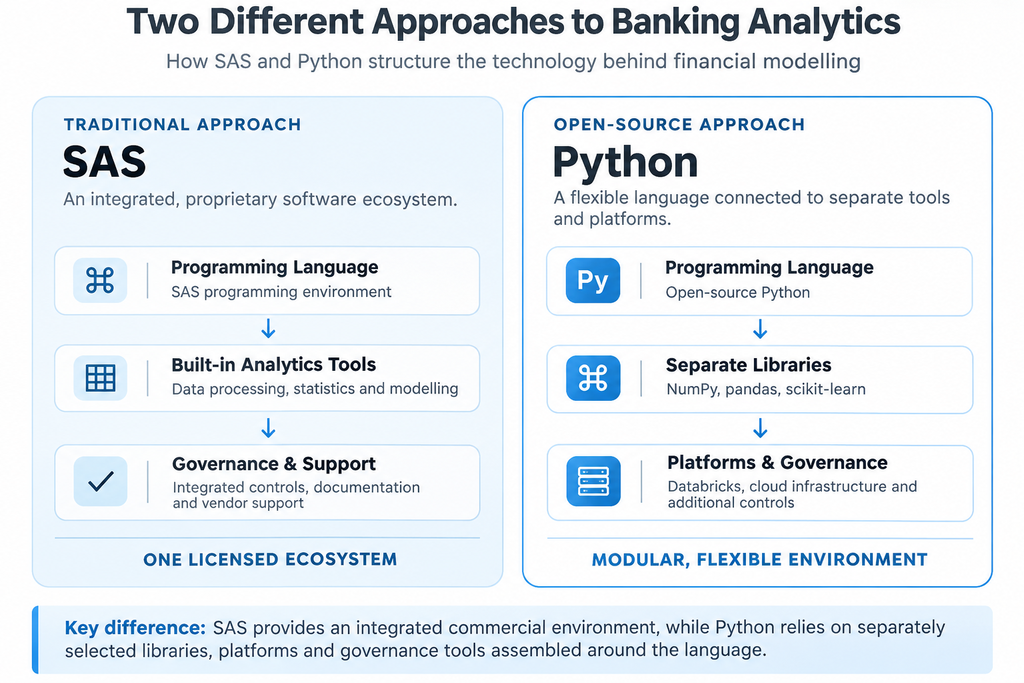
SAS is more than just a programming language. It is a commercial software ecosystem that companies license and use to manage data, develop statistical models, produce reports and run analytical processes. Its established tools offer a tightly integrated environment with extensive documentation, security controls and governance features. Banks have relied on it for decades, particularly in credit-risk modelling. The downside is that licensing can be expensive, its proprietary environment offers less flexibility when integrating newer technologies, and fewer emerging developers are choosing to learn it.
Python, by contrast, is free and open-source. Rather than arriving as one integrated commercial package, it can be combined with thousands of libraries covering everything from statistical analysis and data processing to machine learning and model deployment. It is also easier to integrate with modern data platforms and cloud environments, while its popularity across the wider technology industry gives employers access to a much larger pool of developers.
The distinction matters because banks are not necessarily looking to replace SAS with an identical Python-based system. In many cases, they are modernising the wider infrastructure in which their models operate. Although banks themselves are often reluctant to discuss the technical details of these projects, the companies helping them carry out migrations are more forthcoming. Pipple, for example, describes its work with a mortgage bank that wanted to move its credit-risk models from SAS to Databricks and PySpark. The existing environment was costly and offered limited flexibility, while the client wanted faster processing, easier maintenance and greater scalability.
A separate case study from SENLA describes similar motivations behind a migration for a major European bank, whose existing SAS solution ran on a dedicated server with limited scalability. The client wanted more cost-effective processing while retaining its data on-premise for security reasons.
This additional work is important for another reason. When a bank migrates a production credit-risk model, it cannot simply assume that the new implementation will produce the same results as the old one. Differences in how the two systems process data or implement statistical methods can affect the outputs. Even relatively small discrepancies may have consequences when migrated models are used to assess credit risk.
What This Means for Validators
This is where model developers and validators become particularly important. The new implementation must be tested against the original, with discrepancies investigated and documented before the bank can rely on it. Independent validation teams must also establish that the model continues to perform as intended. For validators, this creates an additional reason to understand the technology used to implement the models they assess. Python proficiency can therefore help them inspect code and work more closely with development teams, even if their primary responsibility remains assessing the model’s methodology and performance.
That does not mean SAS, or its established position in global banking, will disappear anytime soon. According to the company’s own figures, 86% of the world’s 100 largest banks use SAS, while over 5,100 banks operate its software worldwide. Its presence in Poland is also reflected in the continued availability of SAS-focused vacancies and the salaries experienced specialists can command, with some SAS developer roles reportedly paying more than PLN 200,000 a year. The technology also remains deeply embedded in financial institutions’ existing systems, which cannot simply be abandoned overnight.
For professionals working in Polish banking, this makes the transition more complicated. SAS experience continues to open doors, particularly in institutions maintaining established credit-risk systems through legacy models. Indeed, experienced SAS specialists may be among those best placed to support migration projects because they understand the logic and assumptions behind the systems being replaced.
At the same time, Python is increasingly becoming an important requirement for newer modelling and analytical roles. Depending on seniority, responsibilities included model development, coding as well as coordination with validation and audit teams. The advertised salary range extended from PLN 7,100 to PLN 28,000 gross per month, illustrating the breadth of opportunities within this specialist market.
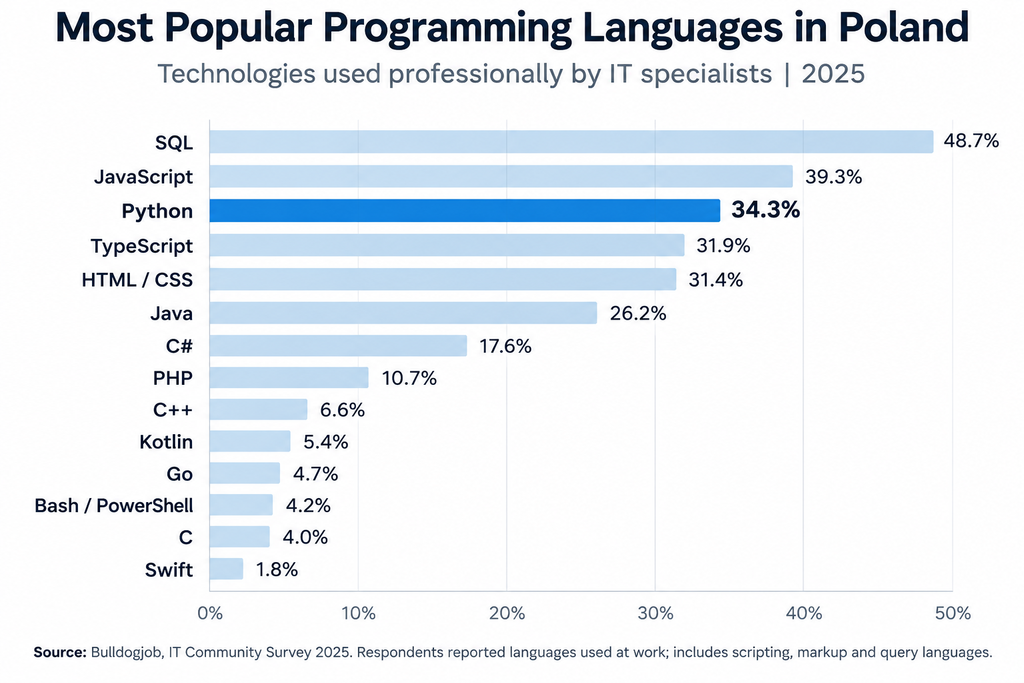
For Poland, there are encouraging signs that the technical foundations needed to meet this demand are already developing. According to one survey, Python was the third-most-used programming language among respondents, with 34.3% reporting that they used it professionally. The country’s educational institutions are also beginning to reflect the growing importance of computational skills in finance. SGH Warsaw School of Economics, for instance, offers credit-risk modelling courses covering practical implementation in both Python and R.
Ultimately, the strongest position for candidates may lie somewhere between the old and new systems. An experienced risk professional who understands credit-risk models, regulatory requirements and SAS, but can also work with Python, has something particularly valuable to offer a bank undergoing technological change. For newer entrants, Python provides an increasingly useful route into financial modelling, although understanding the models themselves remains just as important as knowing how to code them.
The transition is unlikely to happen overnight, but those able to bridge the gap between established banking systems and the tools replacing them could find themselves particularly well placed in Poland’s evolving financial labour market.
Verita HR specialises in permanent recruitment and outsourcing for quantitative, model-validation, credit-risk and technology roles in Poland. As banks embrace latest coding languages, we help firms identify candidates who understand both established modelling environments and the tools now being introduced, and we help professionals position their experience for these hybrid requirements.
Verita HR offers services including Permanent Recruitment | Outsourcing
Author: Michal Pawlak