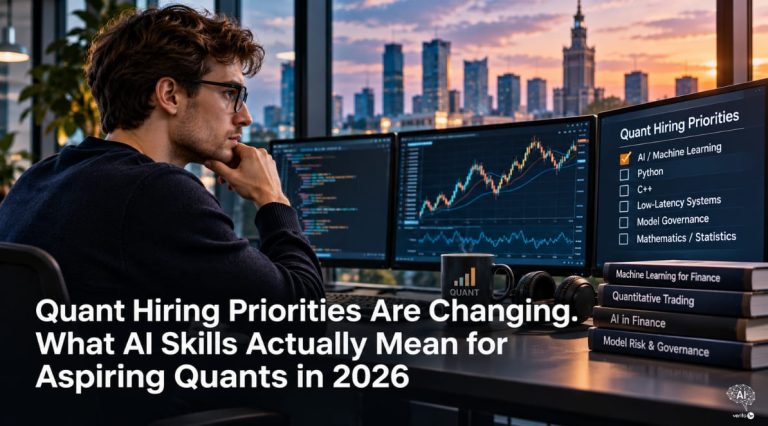
The numbers from a recent Bloomberg survey of 500 London-based financial services professionals landed with some force in the fast-changing world of quant hiring
The study found of those with hiring responsibility, 94% said they would consider someone for a quant role even without a traditional finance or hard-science background, provided the candidate was strong with AI and coding tools. Interestingly, AI emerged as the single most important skill for breaking into quant investing (48%), ahead of mathematics, physics, engineering, or computer science. The same survey showed that 54% had already hired someone from a non-traditional background, while only 18% said no specialist background was required at all.
On the surface this looks like a promising break from the old model of recruiting almost exclusively from traditional academic backgrounds. But in practice, the shift is narrower and more practical. Firms are not abandoning technical depth. What they are looking for are people who can take models into production to work with messy real-world data and challenge AI outputs.
This matches what the market is actually struggling to fill. According to this year’s findings from the professional quant firm CQF, 88% of quant professionals believe a skills gap exists and 76% say the situation is actually getting worse. The sharpest shortages are in advanced machine learning, agentic AI design, and AI model governance, representing the same capabilities that turn research into production systems. Among these, Quant Developers, Quant Researchers, and Machine Learning Engineers remain the hardest roles to hire. Collectively this suggests that classical mathematical modelling and scholastic skills won’t disappear anytime soon, but may no longer be sufficient on their own.
Yet which technical skills are employers actually looking for? KnowQuant’s international vacancy index offers a glimpse of what these requirements look like. Machine learning appeared in 433 listings, making it the second most frequently mentioned skill after Python, which featured in 848. Other frequently requested capabilities included C++ (343 listings), Linux (350) and low-latency systems (310). The figures suggest that demand for AI expertise is developing alongside the established foundations of quantitative work. Firms still need people who can programme and optimise trading systems, but increasingly value candidates who can also apply machine learning techniques within them.
Which skill are quant employers looking for?
Most frequently mentioned skills in quant job advertisements
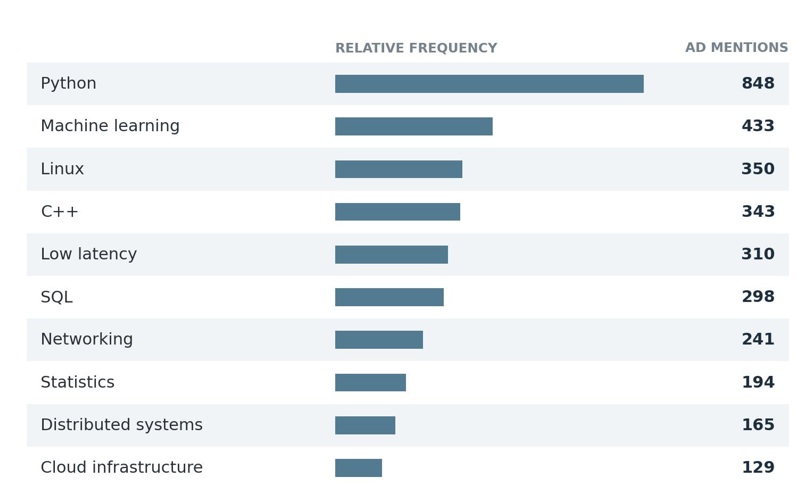
Figures count mentions in job advertisements, not unique or hires. Skills may overlap.
Firms Are Already Acting on the Shortage
The competition for this hybrid talent is now visible in concrete hiring decisions. Citadel recently said it will expand its quantitative investment team (currently around 180 people spanning research and data engineering) to maintain double-digit growth over the next year. The firm is actively recruiting researchers from AI laboratories, including Google DeepMind. Navneet Arora, head of Global Quantitative Strategies, has described the change as one in which researchers become “managers of machines” who generate investment ideas and direct increasingly capable AI systems.
A different but related response comes from Qube Research & Technologies’ QRT Labs in Britain. Launched with Imperial College London, the University of Cambridge, and the University of Oxford, the initiative is supporting more than 70 early-career researchers. In October it welcomed its first cohort of 13 researchers, whose work spans AI and its mathematical foundations, intelligent systems, and decision-making under uncertainty, supporting the pipeline that will produce the next generation of quantitative talent.
It is thanks in part to these projects that make London the deepest quant market outside the United States. Systematic hedge funds and proprietary trading firms such as XTX Markets, Qube, and Quadrature have posted strong revenue growth in recent years, supported by a deep graduate pipeline. Broader finance vacancies in the UK rose roughly 13% year-on-year in 2025, while recruiter consensus puts several thousand active quant positions in the UK, with the large majority in London. In the United States the scale is larger still, with estimates putting the number of financial quantitative analysts around 136,000, with projected growth of roughly 6% between 2022 and 2032.
Poland’s Practical Position
Poland is also becoming a more significant part of the international quant recruitment landscape. Warsaw has attracted growing investment from hedge funds looking to expand their technology and data capabilities outside the traditional financial centres. An August report found that Point72 employed more than 300 people in Poland, while Balyasny had around 100 staff in Warsaw. Qube Research and Technologies, in the context of Poland, had also recruited dozens of engineers and technology specialists pointing to a budding demand for the technical capabilities behind quantitative investing, even if it does not mean that investment research and decision-making are moving wholesale out of London or New York.
Poland also comes with has an established pool of engineering and technology professionals. Eurostat has put ICT specialists at 4.5% of Polish employment in 2025, closely on par with the EU average. The more compelling story lies in the concentration of financial-services employers and specialist technical teams in cities such as Warsaw and Kraków, giving international firms access to people with experience of financial systems, data engineering and quantitative development.
Regulation is adding another dimension to the skills shortage. Under the EU AI Act, creditworthiness assessments of individuals are classified as high-risk AI applications, although the relevant requirements have been delayed until December 2027. Financial institutions therefore have some time to prepare, but will increasingly need specialists who can explain how models reach their decisions and ensure they are properly monitored. Although the legislation isn’t specifically designed to drive quant recruitment, the move represents the burgeoning need for professionals who understand the technical workings of AI systems as well as the risks involved in deploying them.
What This Means for Candidates and Employers
For candidates, AI fluency is emerging as a key practical advantage, albeit not yet a replacement for core quantitative ability. The strongest profiles combine strong foundations in mathematics, statistics, or computer science with demonstrable experience taking machine-learning models into production and understanding model risk.
For employers, the Bloomberg numbers show growing willingness to look beyond traditional backgrounds, but the same survey and day-to-day hiring show that specialist depth remains the norm for most front-office and model-risk roles. This makes geographical reach all the more important. Poland’s established technology workforce and growing financial-services presence offer international firms an additional source of quantitative and engineering talent, particularly for roles supporting research and trading infrastructure.
If you plan to build or scale a quant team in Poland in 2026, treat Quants as a strategic hire, not a generic finance or IT role. And if you want a realistic view of the market: salaries, availability, and what you actually need, Verita HR can help you navigate the noise and secure Quants who are the right fit for your company’s needs.
Verita HR offers services including RPO | Permanent Recruitment | Outsourcing | Media Services
Author: Michal Pawlak
See Also:
Polish Quants Wanted: Guarding Against Risk – Verita HR
Who are the People leading International Quant Teams in Poland? – Verita HR