On this page
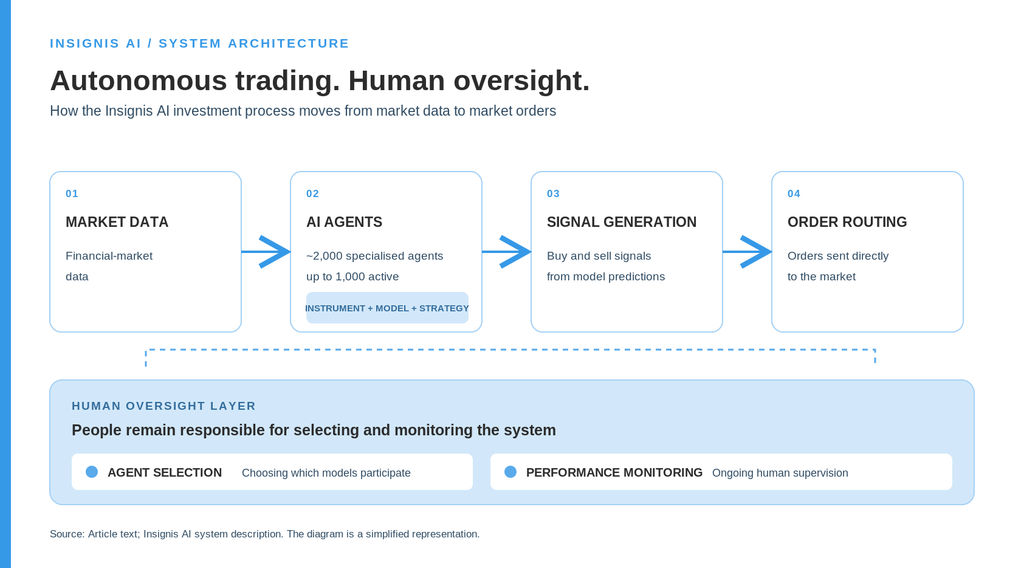
When Insignis TFI announced an investment fund capable of making its own trading decisions, it hinted at where quantitative finance could soon be heading. The proposed system, built around nearly 2,000 AI agents, sends orders to financial markets without requiring a human manager to approve transactions.
It is a curious development for Poland’s investment industry. Because if automated investment strategies become more widespread, they could change how frequently financial markets trade, what regulators expect from investment managers and, perhaps most importantly, which specialists financial institutions need to employ.
Greater Autonomy Than Earlier AI Funds
Insignis Artificial Intelligence FIZ is a closed-end fund developed by Warsaw-based Insignis TFI using technology supplied by Polish company AI Investments. The fund was registered with the country’s Financial Supervision Authority in September. Subsequent reports note that it began operating a month later, recording its first valuation on 30 October.
Its distinguishing feature is the degree of autonomy given to the investment system. Rather than simply analysing market information, the technology is designed to generate its own buy and sell signals and transmit orders directly to the market. Human involvement remains, but principally through selecting the models that participate in the investment process and monitoring their performance.
The system has nearly 2,000 available AI agents, with up to 1,000 expected to operate simultaneously. The technology uses machine learning, including neural networks, to identify recurring relationships in financial-market data and estimate how instruments might behave. And it is quite different from generative AI tools that most people use. Rather than producing text in response to questions, these models are designed to make numerical predictions that can inform investment decisions.
The technology’s development also involved an interesting collaboration between the private sector and academia. AI Investments worked with the University of Oslo and Ulm University under the European Eurostars-2 programme, which supported research into machine learning for portfolio management and risk optimisation. Such partnerships demonstrate how academic research can contribute to the development of commercially applicable financial technology.
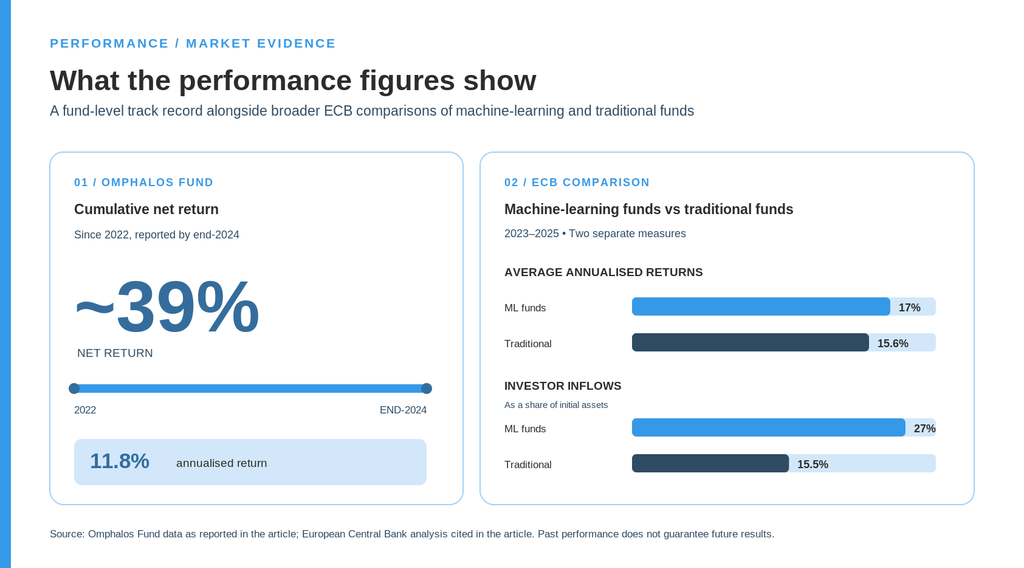
There is also an existing track record. AI Investments’ technology has been used by Luxembourg’s Omphalos Fund since 2022. According to the fund’s data, it had generated a net return of 39% by the end of 2024, equivalent to an annualised return of 11.8%. These figures are encouraging, although they do not establish that the technology will consistently outperform competing strategies.
Nor is Insignis Poland’s first investment fund to incorporate AI. AIXON AI MultiFactor FIZ had already introduced machine-learning techniques into its investment process. The distinction is that Insignis allows its AI system to generate and route investment orders without requiring routine human approval, placing it a step further along the path towards autonomous management.
Performance Gains Bring Market Risks
There are already indications that investment firms have commercial reasons to adopt more AI-driven strategies. A November analysis by the European Central Bank compared funds using machine learning with comparable funds employing traditional investment strategies.
Between 2023 and 2025, the machine-learning equity funds generated average annualised returns of approximately 17%, against 15.6% for their traditional counterparts. They also attracted stronger investor inflows, equivalent to around 27% of their initial assets, compared with 15.5% for non-AI funds.
Yet the potential attraction for investment managers comes with a flip-side for financial markets. The ECB found that AI-driven funds tend to have higher portfolio turnover, meaning they buy and sell their holdings more frequently. If more funds adopt these strategies, the resulting increase in orders could put additional demands on exchange infrastructure.
Poland is already accustomed to automated trading. According to Warsaw Stock Exchange (GPW) figures, algorithmic trading accounted for approximately 23% of turnover on the cash market and 20% on the futures market in 2024. The GPW has also upgraded its trading infrastructure. Introduced in October, its new Warsaw Automated Trading System is designed to process up to 100,000 orders per second, five times the previous system’s capacity, with a target response time of 50 microseconds for 90% of orders.
The more significant concern, however, may be what happens when automated systems react to the same market signals. The ECB also found that AI-driven equity funds show greater dependence during severe negative market movements, making them more likely to experience substantial losses at the same time. If multiple systems attempt to sell similar positions simultaneously, their orders could intensify an existing market downturn.
But the ECB considers the current systemic risk limited because AI-driven funds still account for a relatively small share of the market. Nevertheless, as their use expands, financial institutions will need to understand how their models interact and identify when apparently separate strategies behave in similar ways. That creates a growing role for specialists who can assess how a model behaves in a wider trading environment.
Rules Require Independent Model Oversight
Of course, the growing autonomy of investment systems does not absolve firms of their responsibility to keep them under control. In fact, European regulation already places specific obligations on those using algorithmic trading, making the ability to test and independently assess these systems an increasingly important part of investment management.
Under Article 17 of the Markets in Financial Instruments Directive, investment firms engaging in algorithmic trading must ensure their systems operate within appropriate trading limits and cannot generate erroneous orders capable of disrupting markets. These are binding legal obligations, supported by more detailed technical requirements in Regulatory Technical Standard 6. Its Article 9 requires firms to conduct an annual assessment and validation of their algorithmic trading systems and strategies, involving staff with the necessary technical knowledge.
Regulators are also paying closer attention to how firms manage machine-learning systems once they are deployed. In February, the European Securities and Markets Authority issued a supervisory briefing covering areas such as system testing, outsourcing and changes to algorithms after deployment. While the briefing is not itself binding legislation, it signals how regulators expect firms to apply their existing obligations as trading technology becomes more sophisticated.
This regulatory pressure also has a domestic dimension in Poland. The country’s new Act on Artificial Intelligence Systems, published in July, establishes the Commission for the Development and Security of Artificial Intelligence to oversee the application of AI rules nationally. It sits alongside the EU Artificial Intelligence Act, most of whose provisions became applicable in August. However, the latter does not automatically classify systems used to generate investment signals or manage securities portfolios as high-risk, so the existing financial-market rules remain particularly important for investment managers.
For firms operating in Poland, the challenge is therefore to demonstrate that increasingly automated investment processes remain technically sound and properly controlled. Meeting that responsibility requires people who can scrutinise model design and understand the financial consequences when a system behaves unexpectedly. That makes quantitative risk and model-validation expertise an important part of the industry’s evolving recruitment needs.
Which Quant Roles Will Change
But the growing need for model oversight does not mean that every quantitative role will benefit equally from the expansion of AI. After all, investment firms are also gaining tools that can automate parts of the work traditionally carried out by their own quantitative teams.
AI coding assistants can already help implement established models and process datasets. More advanced systems could take on an increasing share of routine statistical analysis and the testing of investment hypotheses. This may reduce demand for junior roles centred on carrying out these tasks, particularly where the work follows established methods.
Still, investment strategies need professionals who can assess whether a model’s findings make sense and remain reliable as market conditions change. Quantitative researchers will therefore need to focus increasingly on the quality of the assumptions and signals behind AI-generated strategies. Quant developers, meanwhile, will remain responsible for turning models into reliable production systems and ensuring they work correctly within financial-market infrastructure.
The balance may shift most clearly towards specialists capable of challenging automated systems. Model validation and quantitative risk professionals need to understand why a model produces a particular result, where its assumptions might fail and what happens when market conditions change. AI can assist with testing and documentation, but it cannot remove the need for independent scrutiny.
There is also a longer-term recruitment challenge. Junior quants traditionally build their expertise through practical tasks like cleaning datasets and running backtests. If automated tools increasingly perform this work, firms will need to find other ways to develop the next generation of researchers, developers and validators.
The likely outcome is therefore a change in the composition of quantitative teams. Employers may need fewer people for some routine analytical tasks, but greater expertise in model development and financial risk.
Building Poland’s Quant Pipeline
For Poland, this changing demand for quantitative expertise presents an opportunity, although the supply of suitably qualified specialists may become a constraint. OECD figures for 2024 show that STEM subjects accounted for 19.2% of Polish tertiary graduates, placing the country 35th among 38 reporting countries. Natural sciences, mathematics and statistics represented just 4.1% of new tertiary entrants, while ICT accounted for 4.8%. These figures do not measure the availability of quant professionals directly, but they highlight the challenge of developing a deeper pool of specialists with the mathematical and technical foundations that AI-driven investment requires.
However, Poland’s financial technology sector is beginning to cultivate this expertise domestically. The aforementioned AI Investments itself employs around 40 engineers, physicists and mathematicians. The company is also leading a PLN 16.6 million research project running to 2029 with Sygnoko and the University of Bialystok, focused on using AI to predict time-series data for quantitative investment.
This matters because the opportunity created by AI-managed funds opens up opportunities for Polish specialists and technology businesses to contribute to the development. But capitalising on that opportunity will depend on developing a larger pool of people who understand both machine learning and the financial problems these models need to solve.
Insignis AI FIZ offers an early indication of what Poland’s financial technology sector can achieve. Turning that into a broader advantage will depend on whether the country can develop enough specialists to support the next generation of investment systems. For Polish employers, that means competing for that rare talent that mixes programming skills with an understanding of financial markets, and a sober appreciation of the limits of AI.
Verita HR works with firms on permanent recruitment and outsourcing for quant, data and technology roles. If you are mapping the market or building a team in Poland, we can give you a clear view of current compensation, realistic timelines and which profiles actually stick.
Verita HR offers services including RPO | Permanent Recruitment | Outsourcing | Media Services
Author: Michal Pawlak