On this page
AI is gaining ground in Polish banking. PKO Bank Polski took another step in August with the launch of its first sovereign AI agent. But as banks look to expand the technology, who will be responsible for checking its work?
PKO’s third-quarter results, published in November, offered a clue of what the bank hopes to achieve. Its new AI agent, named Agent 0, automatically analyses and classifies incoming messages, reducing the time needed to handle an individual case by around 70%.
On its own, this is a relatively contained application of AI. Agent 0 is not yet making lending decisions or determining whether a customer qualifies for a mortgage. But it illustrates the commercial appeal of AI in reducing the time employees spend processing routine information. The question is how far that motivation will creep into functions where the consequences of a bad decision are considerably bigger.
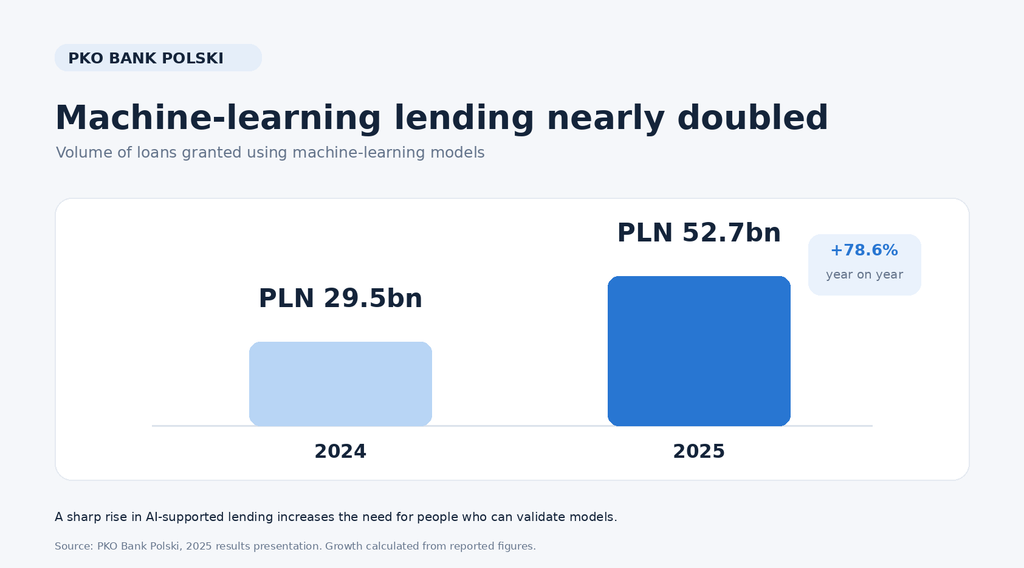
Credit-risk assessment is one area where the technology is already making inroads. PKO is currently recruiting a Data Scientist for its Retail Banking Credit Risk Department, looking for experience with statistical modelling and machine learning, alongside proficiency in Python libraries. This activity is consistent with the bank’s wider investment in AI. According to its 2025 results presentation, the volume of loans granted using machine-learning models reached PLN 52.7 billion, up from PLN 29.5 billion in 2024. PKO attributed the increase in lending partly to improved customer assessment accuracy, with better-performing models allowing it to extend more credit.
But PKO is not alone in strengthening the teams responsible for overseeing these systems. ING Hubs Poland has recently listed a Model Risk Portfolio Analytics & Reporting Specialist position. Its responsibilities include monitoring model risks, analysing model portfolios and developing reporting and analytical tools, with Python and an interest in AI-enabled solutions among the requirements. Interestingly, the vacancy also refers to emerging regulatory demands, including the EU AI Act.
Taken together, these listings suggest that the question is no longer whether machine learning will influence Polish banking. It already does. What matters is whether financial institutions can develop the expertise needed to ensure that increasingly sophisticated models remain reliable.
The models behind modern banking
Machine learning has been used in banking for years. In lending, algorithms can analyse far larger datasets and identify patterns that traditional statistical models might miss, helping banks estimate whether a borrower is likely to repay a loan. But a more sophisticated model is not automatically a more reliable one. Banks still need to understand how it reaches its conclusions, whether it is drawing on sound data and whether its predictions will hold up as economic conditions change.
The difficulty is that some machine-learning systems are far less transparent than conventional models. An algorithm might flag a borrower as high risk after identifying patterns across hundreds of variables, without making it easy to explain which factors drove the result. Models can also become less reliable as customer behaviour or economic conditions shift. For banks, this makes independent scrutiny all the more vital.
The Talent Gap in Model Validation
The problem is finding people who can provide it. Financial institutions need specialists who combine programming and statistical expertise with an understanding of credit risk, model governance and the regulatory environment. That combination is not easy to recruit, and the world’s biggest firms are worried.
Research by McKinsey and the International Association of Credit Portfolio Managers examined the use of generative AI in credit businesses. It found that 41% of respondents considered model-validation issues a barrier to their AI initiatives. At a separate roundtable hosted by McKinsey, 67% of participants identified a shortage of generative-AI capabilities as an obstacle to adoption. The research also found that more than two in five institutions had actually slowed the development of AI use cases because of disappointing results.
Other research points to a broader shortage of specialist skills. A 2024 study by SAS found that half of the banks surveyed ranked the lack of skills to implement AI among their three biggest barriers to adoption. The research highlighted the difficulty of finding hybrid specialists with both technical and functional expertise. The findings of ProSight Financial Association‘s 2026 survey reinforce the problem. Based on responses from 142 risk leaders, the research found that 30% identified limited staff capabilities and training as an obstacle to AI adoption. Meanwhile, only 12% considered their institution’s AI governance and approvals framework to be highly developed.
These figures suggest that the difficulty extends beyond just recruiting people to build AI systems. Banks also need the internal capacity to assess their reliability. Without that expertise, projects can remain stuck in pilot stages or be restricted to applications where failures are easier to manage.
The Risks of Third-Party AI Systems
The challenge becomes even more complicated whenever banks purchase AI systems from external providers. Financial institutions increasingly rely on third-party technology for everything from customer-service tools to analytical platforms. While outsourcing can accelerate adoption, it can also make it harder for banks to understand how a system operates and what might cause it to fail. The Bank of England and Financial Conduct Authority‘s 2026 survey illustrates the scale of this dependency. Third-party implementations accounted for 39% of reported AI systems in 2026, compared with 33% in 2024 and 17% in 2022. They also represented over half of highly material AI systems.
The survey identified oversight of external systems as one of the most significant governance challenges. More than half of respondents, 54%, said they had difficulties applying model-risk-management principles to third-party or vendor-supplied models. A further 49% identified challenges overseeing systems supplied or materially influenced by external providers.
This creates a particular problem for banks using systems whose architecture isn’t fully accessible to them. A technology provider may be able to demonstrate that its product performs well, but the bank still needs to establish whether it is suitable for the specific decisions it intends to support.
Regulatory Expectations Are Tightening
The regulatory environment is reinforcing the importance of these responsibilities. Under the EU AI Act, AI systems used to assess the creditworthiness of people are classified as high-risk, subject to certain exemptions. From December 2027, banks will have to meet stricter requirements for monitoring and overseeing these models, increasing the need for specialists capable of validating them.
The European Central Bank is also sharpening its expectations around internal models. Its updated 2026 Guide to Internal Models addresses the use of data-driven approaches in calculating regulatory capital, including the implications of the AI Act. Banks must still be able to explain and justify the models behind their decisions, regardless of how sophisticated the technology becomes.
The scale of adoption makes this more pressing. The ECB’s November 2026 Financial Stability Review found that the share of eurozone banks actively using generative AI rose from 46% in 2024 to 86% in 2025. As these tools become more widely used, banks will need people who can assess their reliability and manage the risks they introduce.
Poland’s Talent Pipeline for Model Risk
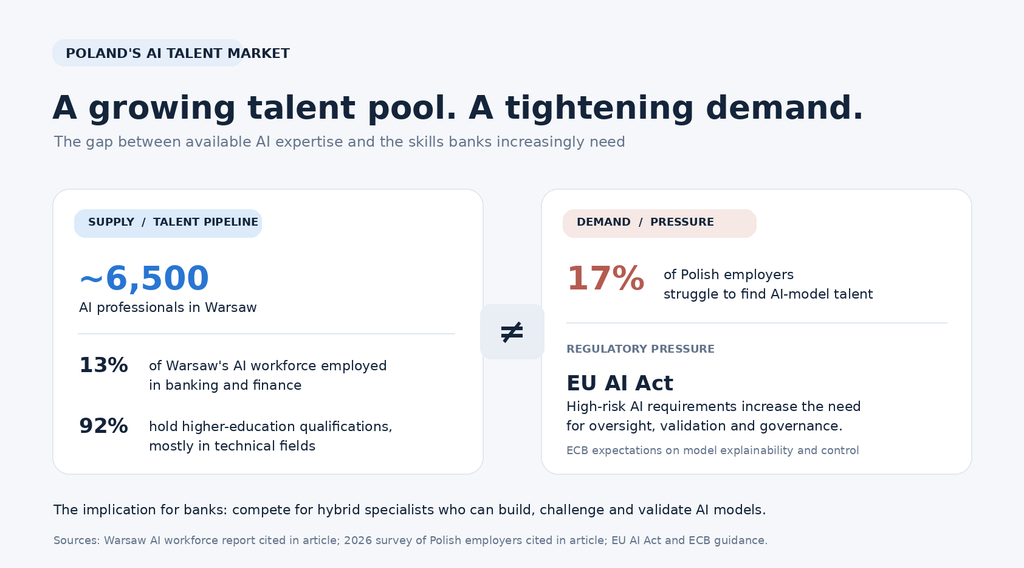
For Poland, this shift could create opportunities, given its sizeable AI workforce for banks to draw on. One report estimates the capital is home to around 6,500 AI professionals, with banking and finance accounting for 13% of employment among Warsaw’s AI workforce. The report also found that 92% of people employed in the city’s AI sector hold higher education qualifications, mostly in technical fields.
The capital also has an established academic pipeline. The University of Warsaw offers a second-cycle Machine Learning programme, while Warsaw University of Technology provides AI-related undergraduate, master’s and doctoral studies. The Warsaw School of Economics also offers programmes covering AI-related subjects, including data analytics and quantitative methods in economics.
Research institutions are contributing too. IDEAS NCBR, established by Poland’s National Centre for Research and Development, supports AI research and the education of future scientists, including through doctoral training. Meanwhile, the Polish Academy of Sciences‘ Institute of Systems Research works on intelligent data analysis, optimisation and computer-assisted decision-making, all relevant foundations for developing more sophisticated model-risk expertise.
But there are reasons to question how quickly this pipeline can meet demand. One 2026 survey found that around 17% of Polish employers already struggle to find candidates with the skills to create AI-based models and applications. Banks are therefore competing for talent in a market where demand already outstrips supply, with upcoming regulatory requirements likely to add further pressure.
Ultimately, the next stage of AI adoption in banking may well depend on more than just being able to build sophisticated models. It will also depend on whether financial institutions can recruit and retain the specialists capable of challenging them.
Verita HR works with firms on permanent recruitment and outsourcing for quant, data and technology roles. If you are mapping the market or building a team in Poland, we can give you a clear view of current compensation, realistic timelines and which profiles actually stick.
Verita HR offers services including RPO | Permanent Recruitment | Outsourcing | Media Services
Author: Michal Pawlak