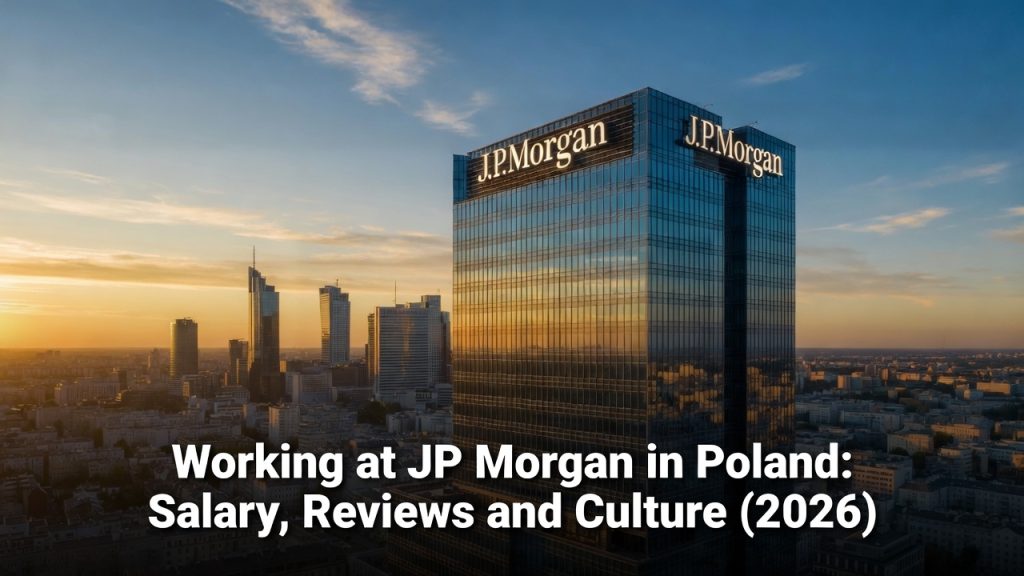
When JP Morgan chose Warsaw for a new operations centre in 2017, then Deputy Prime Minister Mateusz Morawiecki told public radio the bank would hire several thousand people in “well paid jobs”. Reuters reported the work would centre on data management, risk and credit-risk management, and supply chain. Poland had won mid-tier work that London was shedding ahead of Brexit.
Nearly a decade on, the roles the bank advertises in Warsaw look a little different. Recent openings include an Investment Banking Analyst programme covering Central and Eastern Europe, deal execution and deal services associates, treasury and Chief Investment Office product control, regulatory reporting, ESG reporting and internal audit. Some of that is still mid-office and operations reminiscent of the late 2010s, however, much of this work now sits much closer to the front of the bank.
That shift is the real story of JP Morgan in Poland, and it is the question anyone weighing an offer should ask: is a job at the Warsaw hub genuine capital-markets work that builds a career, or more traditional mid- and back-office work under a strong global brand? The picture that emerges from hiring, pay and employee feedback is that the hub has moved a long way toward the former. Outcomes still vary by team, as they do in any large global institution, but the overall direction is clearly upward.
What JP Morgan Actually Does in Warsaw
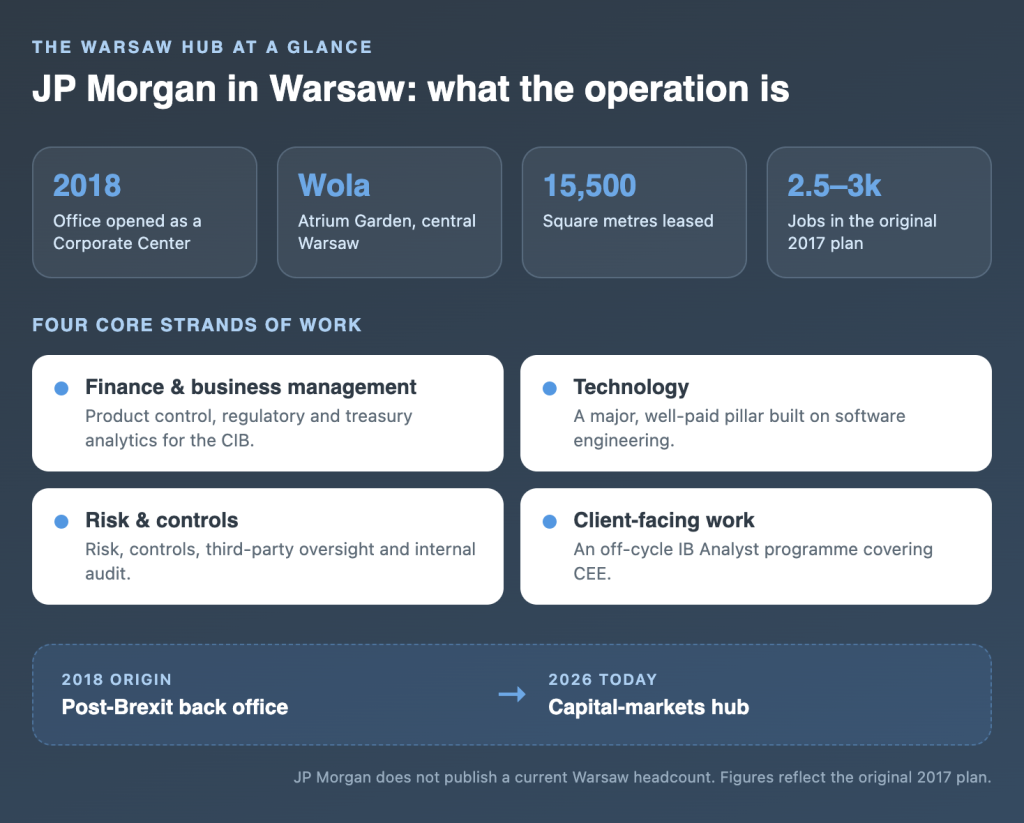
JP Morgan set up its Warsaw office in 2018 as one of the firm’s Corporate Centers, and describes its purpose as helping clients access the capital markets through equity, debt and mergers-and-acquisitions transactions. The centre occupies space in Atrium Garden in the Wola district, where the bank leased around 15,500
The work now spans several distinct areas. Finance and business management for the Commercial and Investment Bank covers product control, regulatory reporting and treasury analytics linked to measures such as the Liquidity Coverage Ratio. Technology is a major pillar, with software engineering a significant and well-paid function. Risk, controls, third-party oversight and internal audit form another core strand. Alongside these sits a growing thread of genuinely client-facing work, including an off-cycle Investment Banking Analyst programme for CEE coverage run out of Warsaw.square metres as it built the operation out.
The spread matters because the employee experience varies by function. A product controller, a software engineer and an IB coverage analyst all support the firm’s capital-markets work, yet their day-to-day roles and career paths differ, as is typical in any large global bank.
How the Warsaw Hub Grew From a Brexit Back Office
The Warsaw hub was created as part of the post-Brexit reshaping of European banking operations. As UK banks looked to move jobs out of London, Poland positioned itself for the mid- and back-office work that came with that shift. JP Morgan’s announced target in 2017 was around 2,500 jobs, with the Polish government citing a figure of up to 3,000 over the following few years. The bank was not alone. UBS built a global hub in Krakow, and Goldman Sachs expanded its Warsaw presence over the same period.
There is one important caveat to mention here. JP Morgan does not publish a current headcount for its Polish operation. The widely repeated 2,500–3,000 figures refer only to the original 2017 plan. Any later number should be treated with caution unless it comes directly from the bank or a primary source. What is clear is that the operation has grown well beyond its initial footprint and moved up the value chain, a more meaningful measure than any single staff figure.
JP Morgan Warsaw Salaries: What the Roles Actually Pay in 2026
Pay is where the two-tier nature of the hub shows most clearly. It is also where published figures need the most care. Aggregators frequently display JP Morgan’s US salaries, sometimes in dollars, on pages that appear to describe Warsaw. Those numbers are not Polish pay and should be approached with caution.
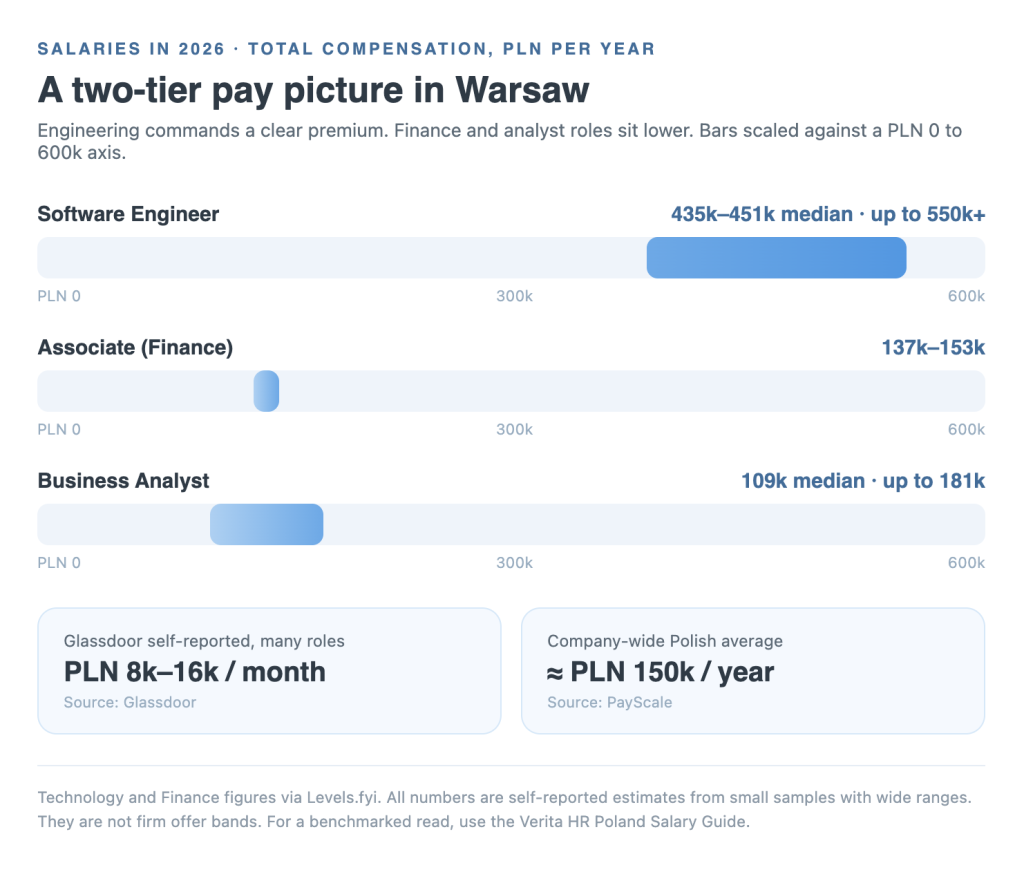
On the technology side, data on Levels.fyi puts software engineer total compensation in the Warsaw area at a median of roughly PLN 435,000 to 451,000 a year. The site gives a reported range from about PLN 386,000 to more than PLN 550,000 at the top. Those are total-compensation figures from a small, self-selected sample, so they read high, but they signal clearly that engineering commands a premium at the hub.
Finance, analyst and associate roles sit a little lower. Levels.fyi reports associate total compensation clustering around PLN 137,000 to 153,000 a year. Business analyst pay is at a median nearer to PLN 109,000, rising toward PLN 181,000. Glassdoor’s self-reported Warsaw entries show many roles in the region of PLN 8,000 to 16,000 a month. PayScale puts the company-wide Polish average near PLN 150,000 a year.
JP Morgan Warsaw Glassdoor Reviews: Brand and Pay Against Bureaucracy
The employee picture is solid but qualified. JP Morgan’s Warsaw reviews on Glassdoor average 3.3 out of 5 across 89 entries. Compensation and benefits score 3.8, diversity and inclusion 3.9, and work-life balance 3.3. Reviews filed under the JPMorganChase Poland entity are similar, at 3.9 across 122 entries, with the strongest ratings coming from those in associate roles.
The praise is consistent. Employees point to the strength and recognition of the brand, benefits and paid time off that beat local norms, and the chance to learn inside a large, well-run institution. For someone early in a finance or technology career, the name on the CV carries weight across the whole Warsaw market.
The more critical comments are also consistent. Some reviewers mention limited scope for personal development in certain teams, variable quality of middle management, and the firm’s move toward fuller office attendance. A few note that workload can be uneven, which is common in process-oriented functions inside large institutions. None of these points should be read as a company-wide verdict; positive and critical reviews sit side by side.
How Far Has the Warsaw Hub Moved Up the Value Chain?
Put the hiring, the pay and the reviews together and the picture is one of clear progress alongside the normal variation found in any large global operation.
The direction of travel is clear. A hub that opened to absorb data management and risk-reporting work now runs product control for trading desks, treasury analytics, ESG and regulatory reporting, and an investment-banking analyst programme covering the region. That is a move up the value chain, and it mirrors what the wider Polish business services sector has been doing. The ABSL 2026 report shows the sector shifting from adding headcount to building capability, with knowledge-intensive and complex mid-office work now the majority of what these centres deliver.
Variation by team remains real. Some reviews that praise the brand also note roles with more limited stretch or slower progression. The higher-value seats in engineering and front-office-adjacent finance are well established, while other functions retain more of the original mid- and back-office character. For a candidate, the practical implication is that the specific team, its mandate and the degree of ownership the role carries matter as much as the brand itself.
How JP Morgan Warsaw Fits Poland’s Banking Near-Shoring Cluster
JP Morgan is one node in a much larger network. Poland’s business services sector passed half a million employees in early 2026. Warsaw and Krakow each host around 100,000 people in the sector. International banks form a dense part of that cluster. This includes UBS in Krakow and Goldman Sachs alongside JP Morgan in Warsaw, which means the bank competes for finance, technology and controls talent against rivals that a candidate can often reach within the same city.
That competition is the backdrop to the retention challenge visible in the reviews. In a market where an experienced product controller or compliance specialist has real alternatives, limited progression and rigid attendance rules carry a cost. It also shapes how these employers need to think about hiring and employer brand, a theme Verita HR examines in its analysis of how AI is reshaping Polish banking and fintech hiring and in its guide to the mistakes that cost employers tech talent in Poland.
What This Means for Employers and Talent in Poland
For talent, the practical lesson is to look closely at the specific role and team. A JP Morgan position in Warsaw can offer a strong platform in capital markets, finance or engineering; the degree to which it does so depends on the mandate and ownership the role carries. Those are the questions worth asking in an interview.
For employers building or scaling operations in Poland, JP Morgan’s trajectory is instructive. The centres that thrive are those that keep climbing the value chain and give people genuine room to grow. In a cluster this competitive, matching what leadership promises with what managers actually reward is what separates a hub that retains its specialists from one that develops them for a rival.
Verita HR works with employers across Poland and Central Europe on talent strategy, employer branding and building teams that hold their best people. To discuss hiring, market benchmarks or competing for finance and technology talent, get in touch with Verita HR.

See Also:
Poland Salary Guide 2026: IT, Finance & Engineering Pay Benchmarks
Working at Revolut Krakow: Culture, Reviews & Work-Life Balance (2026)
Revolut’s Poland Expansion: 300 Jobs and a New Warsaw Office