Hiring tech talent in Poland should be easier than almost anywhere else in Europe. Employers in the country report less difficulty filling roles than the global average, 57% against 72% worldwide, according to the ManpowerGroup 2026 Talent Shortage Survey. The talent pool is deep, English proficiency is high, and the business services sector has just crossed half a million employees.
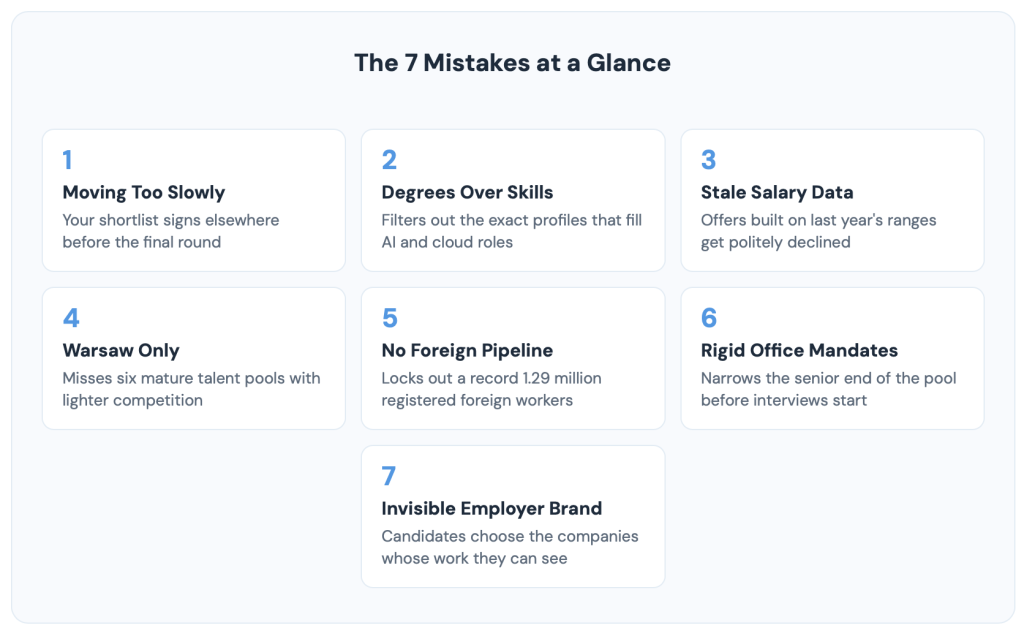
Yet, plenty of companies still lose their preferred candidates, and usually for reasons within their own control. These are the seven mistakes that come up most often.
1. Moving Too Slowly Through the Process
Poland is a candidate-driven market for experienced engineers. Strong candidates routinely hold multiple offers, and hiring speed directly affects outcomes. A three-round process spread across six weeks does not read as thorough. It reads as indecisive, and by the final round the shortlist has already signed elsewhere. Companies that compress scheduling, give feedback within days and pre-approve offer bands consistently win candidates from slower competitors.
2. Screening on Degrees Instead of Skills
The market has moved to skills-based hiring, and even the law has followed. Under regulations effective March 2026, professional experience is now formally recognised alongside university education for foreign hires. Filtering CVs on computer science degrees cuts out self-taught engineers, bootcamp graduates and career changers, exactly the profiles that fill AI and cloud roles where formal curricula lag the technology by years.
3. Benchmarking Salaries on Last Year’s Data
Wage growth has slowed, but the baseline has moved. In 2025, 80% of Polish companies raised salaries, though only 10% offered increases above 10%, according to the Hays Poland Salary Guide 2026. Offers built on 2024 ranges get politely declined, while overpaying across the board strains budgets. Specialisation matters more than title: AI, cloud and data roles command clear premiums over generalist positions at the same seniority.
4. Treating Warsaw as the Whole Market
Warsaw is the largest tech hub, and the most competitive and expensive one. Krakow, Wroclaw, the Tricity, Poznan, Lodz and Katowice all hold mature talent pools where competition for the same profile is measurably lighter. Employers who define the search by skills rather than postcode reach more candidates at better rates, particularly for hybrid and remote-friendly roles.
5. Ignoring the Foreign Talent Pipeline
A record 1.29 million foreign nationals are now registered for social security in Poland, and inflows of international workers are one reason talent shortage pressure has eased across the sector. Companies without a work permit and relocation process lock themselves out of a substantial share of the available market. The 2026 rules have made this easier, including a reduced minimum contract duration of six months.
6. Underweighting Flexibility
Hybrid work is now the norm in Polish IT, and while fully remote roles are declining, flexibility remains a decisive factor for candidates. A rigid five-day office mandate narrows the pool before the first interview, and it narrows it most among the senior engineers every employer is competing for. Flexibility has become part of the compensation package rather than a perk.
7. Neglecting the Employer Brand
The war for talent in Poland is no longer about volume, it is about being chosen. Senior engineers research prospective employers the way employers research them: tech stack, review sites, how the company talks about AI and career development. A company with no visible engineering culture is asking candidates to take its word for it, against competitors who show their work.
Getting Hiring in Poland Right
None of these mistakes is difficult to fix, but all of them are difficult to see from inside the organisation, and harder still from outside the country. A recruitment partner on the ground benchmarks salaries against live placements, screens for skills rather than paperwork and keeps the process moving at market speed.
Contact Verita HR to talk about hiring tech talent in Poland.

See Also:
How to Retain Tech Talent for More Than Two Years – A Talent Retention Strategy