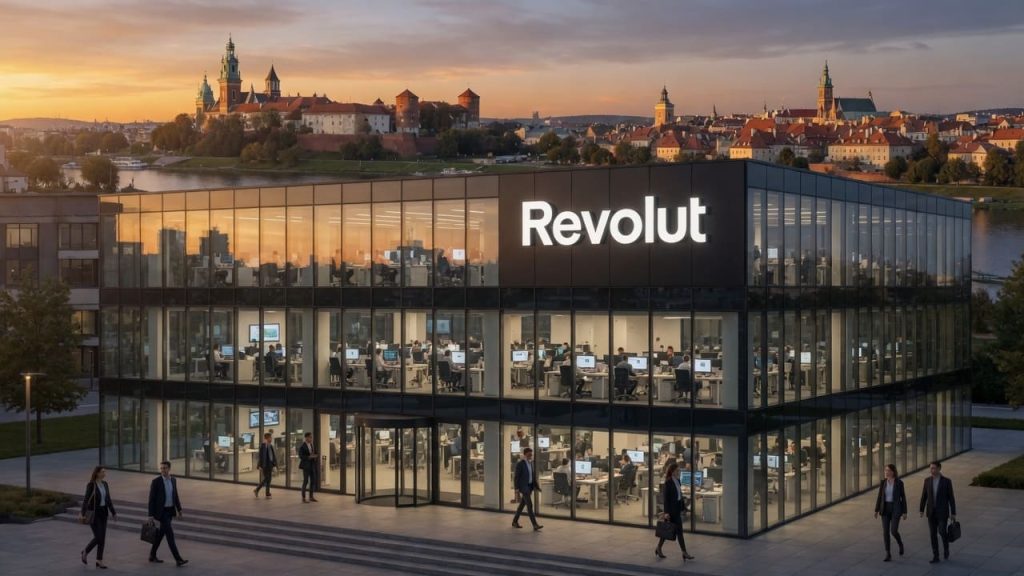
When a Financial Times feature published earlier this month examined the thorny question of work-life balance at European start-ups, it framed a debate that has been raging across the continent: can high-growth start-ups coexist with Europe’s expectations around work-life balance? Few companies sit closer to the centre of that debate than Revolut.
Co-founder and CEO Nikolay Storonsky, a leader famous for his “get shit done” office signs and his belief that transformative companies are not built on 40-hour weeks, has argued on the record that European start-up workers are “protected, entitled” and value work-life balance more than their peers in the US or China.
This article examines where that debate becomes concrete: Revolut’s Krakow hub, where a London-built, high-performance fintech culture has operated inside the Polish labour market for nearly eight years. Krakow is a live test of whether Revolut’s start-up culture can scale in Europe without breaking.
The question HR professionals and talent leaders are now asking is: is that experiment working, and what does it tell companies trying to transplant global ambition into local soil?
Revolut’s Core Values and High-Performance Culture
Revolut’s cultural DNA is not subtle. Its five non-negotiable published values: Get It Done, Never Settle, Think Deeper, Dream Team, and Deliver WOW, have been in place since the company’s early years and have never been softened. The company’s own account of its culture is unusually blunt about what those words mean. It states plainly that “not everyone is meant to be aboard the rocketship.”
Revolut’s careers materials define “get it done” in similar terms: “respect at Revolut comes from sweat and stretch.” In practice, the values translate into measurable output, fast decisions, individual ownership, and a low tolerance for missed targets.
The model has a commercial record behind it. Revolut reported $6 billion in revenue and a record £1.7 billion pre-tax profit for 2025, its fifth consecutive profitable year, with 68.3 million retail customers and a $75 billion valuation.
The same operating model was commercialised in 2024 with the launch of Revolut People, the HR platform the company built for its own scaling, now sold to external clients.
Why Revolut Chose Krakow as a Talent Hub in Poland
Krakow was a deliberate strategic choice, though not an obvious one for a London fintech unless you look at the numbers. ABSL data from Q1 2025 puts nearly 108,000 people working across 312 business service centres in the city, one of only two Polish cities above that threshold.
Revolut entered early: in 2019 it leased 5,300 sqm at Podium Park with approximately 700 workstations, at the time the company’s largest service centre in Europe, recruiting customer support specialists, compliance analysts, and engineers.
Verita HR’s own analysis of the Krakow IT market confirms continued demand growth in AI, cloud, and cybersecurity, despite a tighter hiring climate overall.
Revolut Krakow Hiring Process & Talent Programmes
The Krakow culture was not an accident of geography. Revolut exported a set of mechanisms.
The first is a deliberately high hiring bar. Head of talent programmes Queenie Li told Sifted that: “our values aren’t posters on a wall; they drive how we work every day,” describing a process built on online tests, skills assessments, and values-fit interviews. Plus a 2:1 degree threshold for its Rev-celerator Graduate Programme, rebranded in 2026 as the Graduate Programme. Candidates are screened for tolerance of pace before they ever sign.
The second is community building around the engineering brand. The RevDev programme, a series of technical community events, started in Revolut’s Krakow office on 21 June 2022 and grew into recurring tech events across Polish cities, positioning Revolut inside the local developer scene rather than above it. The initiative was designed, in the words of Revolut’s Head of Engineering for Revolut Business, Wojtek Ptak, to make knowledge open and accessible for all. By 2025, the company was planning an expanded RevDev calendar to deepen its roots in the local tech community.
The third is the working model itself: company-stated remote-first and hybrid patterns across Poland, paired with performance management that emphasises measurable goals. Internal review and promotion mechanics are not published in detail, so this article describes them only as company-stated and employee-described, not as an audited fact.
Revolut Krakow Glassdoor Reviews 2026: 4.1 Rating & Work-Life Balance
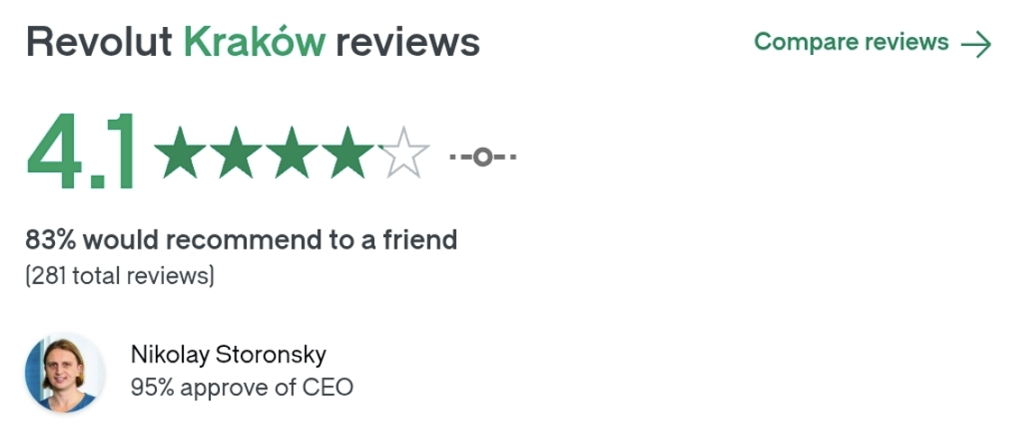
The pitch works on a specific kind of person. At the time of writing, Revolut’s quantitative picture from Glassdoor’s Krakow-specific reviews shows 281 anonymous reviews. This is mixed in ways that illuminate the trade-off with precision.
The headline figure is broadly positive: a 4.1 out of 5 overall rating, 83% recommendation rate, and 95% CEO approval. Compensation scores 4.3 and career opportunities 4.2. Work-life balance, the metric at the centre of the European start-up debate, lands at 3.6.
The written reviews explain the gap. Krakow employees consistently praise talent quality, learning velocity, and career momentum.
“Strong performance culture, high talent bar, ability to learn from top-tier talent — amazing career growth opportunities oriented to employee performance, not procedures,” wrote a Krakow-based team lead of more than five years in May 2026.
It is a yes for ambitious talents in Krakow, specifically, because although the city has thousands of stable, process-driven service-centre jobs, Revolut offers something different: exposure to product decisions, financial crime work, and engineering at the scale of 68 million customers, with career acceleration tied directly to output.
For high-agency employees whose alternative is slower corporate rhythms, the trade is attractive, and they often know exactly what they are signing up for, because the company advertises it.
Criticisms of Revolut Work Culture in Krakow (Glassdoor & Blind)
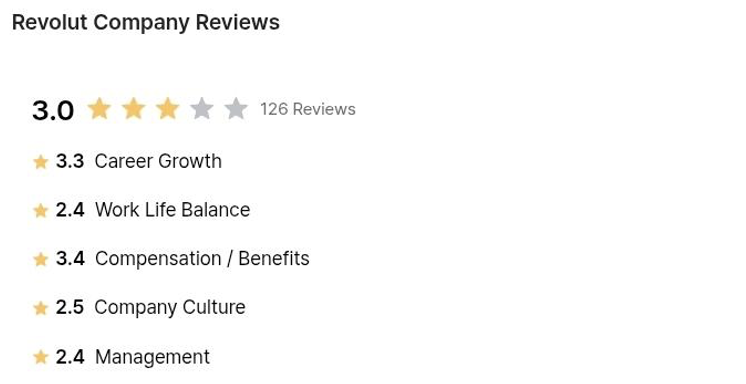
The criticisms are as consistent as the praise. Anonymous reviews on Blind score Revolut’s work-life balance at 2.4 out of 5 as of June 2026, against a 3.4 for compensation. One January 2026 reviewer who otherwise praised the learning environment warned: “Expect to work like a dog with rapidly changing priorities.”
Recurring critical themes across Glassdoor, Blind, and GoWork.pl include long hours in some functions, fast-shifting goals, fear of underperformance, and uneven management quality between teams.
None of this should be read as a verified company-wide fact, and positive reviews frequently appear alongside it, but the pattern repeats too often to dismiss.
Poland has also produced some of the hardest reporting in Revolut’s history. In 2020, Wired reported that support staff in Krakow and Porto were pressed during the pandemic to accept changed terms or resign, an episode Revolut later acknowledged was handled badly.
Poland’s 4-Day Working Week Pilot vs Revolut’s High-Intensity Culture
Against this backdrop, Poland’s own shifting workplace norms become directly relevant to the question that HR leaders across Central Europe care most about: can a high-pressure global employer sustain its talent pipelines in a market that is changing beneath its feet?
Traditionally, Polish work culture emphasised diligence and hierarchical loyalty. After-hours contact was historically uncommon, and private time was considered genuinely private. That picture is shifting, particularly among younger IT workers. Poland launched a government-funded four-day working week pilot in 2026 with 90 employers participating, reframing expectations around sustainable performance.
Forum discussions in Polish tech communities flag burnout risk as a serious consideration for anyone weighing a Revolut offer. And when reviewers note that KPI pressure “decreases collaboration between teams because everyone is under the same pressure,” they are describing exactly the kind of dynamic that increases voluntary attrition in a market where engineers have genuine alternatives.
Revolut’s own 2025 Annual Report noted certification as a Great Place to Work in 14 countries, including Poland. The certification reflects formal workplace architecture, not always the day-to-day picture.
Can Revolut’s Krakow Culture Scale Sustainably?
Revolut itself has conceded that the culture needed work. From 2021 onwards it brought in behavioural scientists and psychologists, and built a dedicated CultureLab team in 2023 to embed values-based behaviours and push a more “human”, approachable management style, partly under regulatory pressure as it pursued banking licences.
With a full UK banking licence secured on 11 March 2026 and a US national bank charter application filed, according to its 2025 Annual Report, the compliance stakes keep rising, and regulators increasingly treat culture, governance, and staff conduct as supervisory issues. Maturity is no longer optional branding; it is a licensing condition.
Whether the Krakow model is sustainable therefore depends on three things the company largely controls: the consistency of manager quality across teams, retention of experienced compliance and operations staff in a city where rivals can hire them within walking distance, and whether “never settle” continues to mean ambitious goals rather than permanently moving ones.
The evidence so far is genuinely mixed, and it is more honest to say so than to declare the question settled in either direction.
Lessons for HR Leaders: Transplanting Startup Culture to Poland
Revolut did not stumble into a start-up culture in Krakow. It exported one deliberately, with high hiring standards, explicit values, fast feedback, and rewards for people who run at its pace. That is also why the model polarises: the same selectivity that produces a 4.1 local Glassdoor rating produces a 2.4 work-life balance score on Blind.
The Krakow case suggests Silicon Valley-style intensity can work in a European talent market, but only for the people it was built for, and only as long as the company keeps proving that high performance does not require avoidable burnout.
For the HR and talent professionals Verita HR serves across Poland and the wider region, the precise lesson is this: culture transplants require more than community events and values frameworks. They require sustained alignment between what leadership articulates and what managers actually reward day to day.
In a Poland that is piloting four-day workweeks and where a generation of engineers is choosing employers deliberately, the cost of that misalignment is rising. And the next employer willing to offer something different is never very far away.
Get in contact with Verita HR to support your organisation in navigating talent strategy, employer branding, and people operations across Poland and Central Europe.
Author: Richardson Chinonyerem
See Also:
Krakow’s Tech Revolution Sparks a New HR Frontier
How AI Is Reshaping Polish Banking and Fintech Hiring: Roles, Gaps and 2026 Priorities