As the global race for quant talent heats up, major investment firms are looking further down the recruitment pipeline, funding research and university programmes to court promising candidates early. For smaller markets such as Poland, where institutional resources may be harder to come by, nurturing that talent requires different routes. Yet Polish participants have been making significant strides in international competitions, achieving results that point to a much stronger domestic pool than is often recognised.
Last month, WorldQuant earned the Guinness World Record for organising the Largest Finance Competition at the International Quant Championship. The event, whose finals were held in Singapore on October 7, drew unprecedented participation, with 73,496 competitors from 167 countries, drawn from an initial pool of 156,000 registrants (nearly doubling the previous year’s numbers). Each competed for a prize pool of $100,000 by building and testing quantitative investment ideas (alphas) on the WorldQuant BRAIN simulation platform. A Nigerian student was declared the overall winner, a result widely covered by the international press.
Strong Polish Results, Limited Domestic Coverage
Behind the headlines, however, the performances of several Polish participants stand out. Among the 38 Polish teams that took part, Blazej Radzik, a student at the University of Economics in Katowice who competed individually, ranked first in Poland in both the first and second stages of the challenge and ultimately finished in the top 0.6% globally. Impressive as these results were on the international stage, they received little domestic attention beyond the participants themselves.
This media gap becomes even clearer when larger achievements receive similarly limited coverage in Poland. In February, the Rotman International Trading Competition in Toronto brought together 250 participants to compete in simulated financial markets covering algorithmic trading, options, market making, commodities, liquidity, and risk management. The University of Warsaw team finished second overall, just one point behind Baruch College of New York. This was not an isolated result as the same team placed second in 2023, fourth in 2024, and third in 2025. Despite this sustained level of performance on the global stage, the achievement attracted only limited attention in the Polish financial press.
Another overlooked result came from Riyadh, where last year the University of Warsaw’s Faculty of Economic Sciences participated in the Algo Trading Challenge alongside 800 students from 49 countries. Competitors developed algorithmic strategies across three asset categories: equities, foreign exchange, and commodities. The Polish team secured third place in the “Best Return” category. Alas, coverage was minimal, with the university itself largely responsible for publicising the outcome. Poland’s presence in the IMC Prosperity challenge similarly went largely unreported. Held in April 2026, the five-round online trading and algorithmic challenge for university STEM students drew more than 30,000 participants, representing 18,803 teams across 1,174 universities and 117 countries, including 80 Polish teams. One Polish participant finished 216th overall, placing in the top 1.15%. Once again, visibility depended primarily on social media posts from those involved.
Why the Lack of Attention Matters
Such limited coverage is a significant missed opportunity, particularly in the quant hiring market. For a country that may lack the same monetary inducements as larger quant centres eager to attract talent from abroad, recognising excellence in premier championships becomes an important way to level the playing field, support the development of aspiring quants, and retain them. As the results above demonstrate, Poland already has substantial talent to highlight.
Greater attention to competitions of this kind should form part of the quant talent pipeline. It’s a point reinforced by the established relationship between media exposure and career interest. Academic research examining more than 15,000 first-year U.S. university students found that exposure to STEM-related media during high school (including television programmes, online videos, and video games) was positively associated with interest in STEM careers.
The pattern is evident outside academia as well. In 2020, the release of Netflix’s The Queen’s Gambit triggered a sharp rise in public interest in chess, with one major online chess platform gaining roughly one million new members per month during the peak. Entering quant competitions and navigating the associated job market is, of course, more demanding than starting a game of chess. Nevertheless, media exposure can play a meaningful role in inspiring people to enter the field. This is illustrated by a 2018 LinkedIn Talent Solutions case study showing that Citadel’s quantitative finance data competitions attracted over 10,000 participants and generated a hiring pipeline from which dozens of candidates were recruited.
Of course, major firms will continue to invest in training pipelines to secure the volume and calibre of candidates the market requires. That investment thrust is not going away. At the same time, it is not a reason for smaller markets to rely solely on external actors with deep pockets. The quant hiring landscape can be strengthened through consistent media attention that showcases excellence, encourages broader participation, and helps address the already high barriers to entry in this competitive sector.
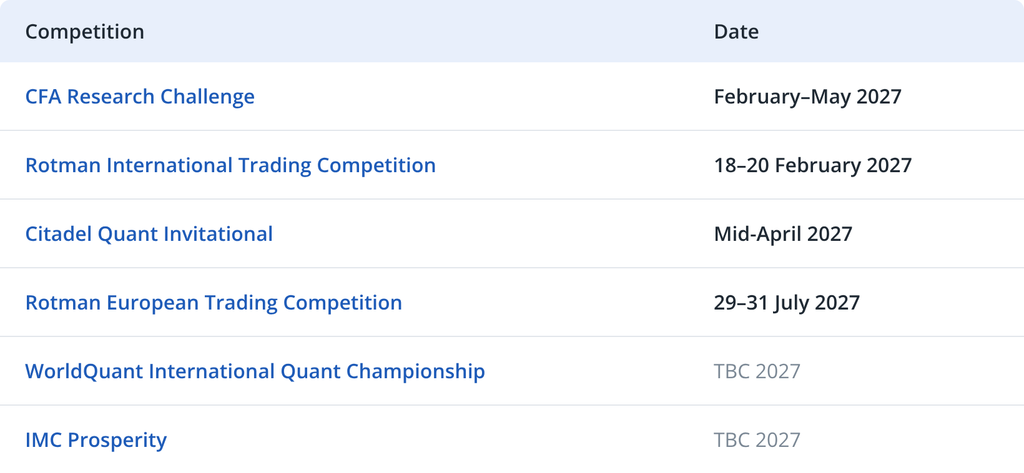
That is why Verita HR will keep a keen eye on the upcoming championship events, including:
Verita HR works with firms on permanent recruitment and outsourcing for quant, data and technology roles. If you are mapping the market or building a team in Poland, we can give you a clear view of current compensation, realistic timelines and which profiles actually stick.
Verita HR offers services including RPO | Permanent Recruitment | Outsourcing | Media Services
Author: Michal Pawlak