
Every quarter an AI role sits unfilled, someone else’s roadmap moves. In Poland 2026, the cost of that vacancy is no longer abstract. The impact shows up in delayed product releases, wage inflation, burned-out teams, and in regulated industries and compliance exposure.
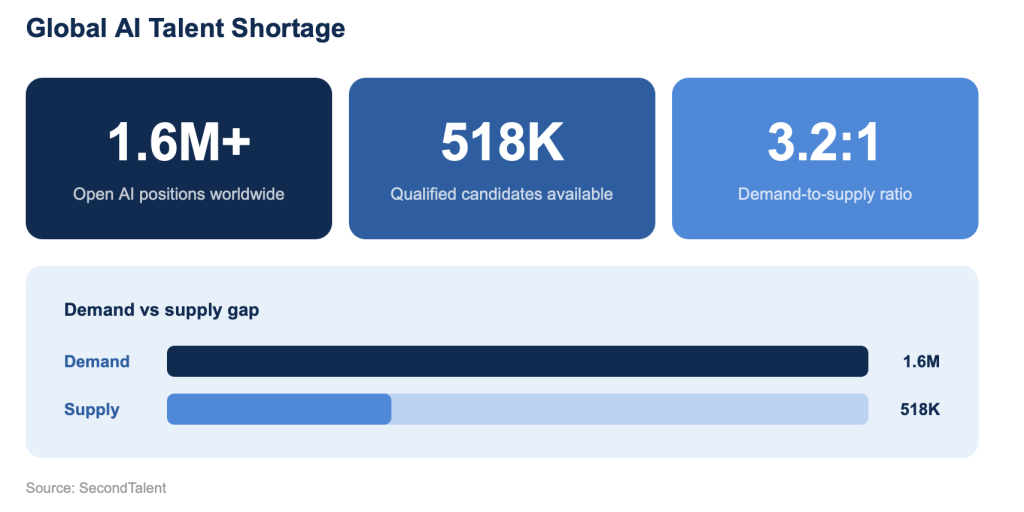
The global AI talent shortage has reached a point where demand outpaces supply by a ratio of 3.2 to 1. There is now over 1.6 million open positions and only 518,000 qualified candidates available worldwide.
The companies that move fast win. The ones that stall are paying for it, whether they see it on a balance sheet or not.
The Ambition Gap: Everyone Wants AI. Almost No One Is Ready
The market has already moved. Research predicts that AI and machine learning skills will be among the fastest-growing roles through 2030, while 86% of employers expect AI and information-processing technologies to transform businesses.
Research by McKinsey says 92% of companies plan to increase AI investment over the next three years. However, only 1% of leaders consider their organizations mature in how AI is deployed across workflows and business outcomes.
Whilst it’s clear companies want the positives of implementing AI, it’s clear most still do not have the people to capture it.
Poland’s Digital Skills Gap Is Now a Business Risk in 2026
For employers in Poland, the pressure is more than many leaders admit. The European Commission’s 2025 Digital Decade report on Poland explains that the shortage of ICT specialists is already affecting enterprise digitalisation, advanced technology adoption, and cybersecurity.
Poland’s digital-skills profile shows basic digital skills at 44.3%, below the EU average of 55.56%, while ICT specialists account for 4.5% of employment against a 5% EU average. That is not a trivial gap when companies are trying to move from AI experiments to production.
Below are the four most realistic costs of an unfilled AI role in 2026.
Cost One: Every Open Role Is a Stalled Roadmap
Most companies still calculate the cost of attrition too narrowly. They add up recruiter fees, job portal spend, and maybe a signing-on bonus. That misses the real number.
The first cost is delayed execution. If the role sits open, product releases move slower, internal AI tools stay stuck in pilot mode, and teams already in place keep working around capability gaps instead of through them.
Skills gaps in AI operations triggered digital transformation delays of up to 10 months for nearly two-thirds of organizations surveyed. More than three in five reported missed revenue goals and product delivery failures directly linked to those gaps. Customer satisfaction dropped too.
Two-thirds of organizations already report productivity and efficiency gains from AI. Yet of 3,235 business leaders surveyed, only 20% are already growing revenue through AI initiatives, while 74% still hope to do so in the future.
Many firms implement enough AI to save time, but not enough execution strength to turn that into durable growth.
Cost Two: The Longer You Wait, the More You Pay
As an example, research shows that in the UK job postings asking for AI skills carry an advertised salary premium of 23% over otherwise comparable roles. Further research suggests that AI roles already command a 67% salary premium over traditional software positions. That premium is growing at 38% year-on-year (YoY) across all experience levels.
Research shows that job postings asking for AI skills carry an advertised salary premium of 23% over otherwise comparable roles, and this premium continues to grow. In Poland, senior AI/ML engineers are among the highest-paid IT specialists. On B2B contracts, senior rates commonly range from 35,000 – 55,000+ PLN net per month, with top specialists starting at 40,000 – 52,000 PLN net/month and occasionally reaching significantly higher.
This matters in Poland because the country has real tech talent, but they are sometimes overstated. The Polish Investment and Trade Agency (PITA) says the country has around 600,000 programmers and more than 70,000 students in ICT-related majors. That is a strong foundation. However, it is not the same as having a deep bench of production-read machine learning engineers, DevOps specialists, and sector-specific AI product talent. The difference matters.
As Michalina Krywult, AI recruitment specialist at Verita HR, explains: “artificial intelligence is no longer a ‘nice-to-have’ but a core driver of business transformation in Poland…. That’s why salaries are rising and competition for mid- and senior-level AI/ML talent is so intense.”
Cost Three: The Work Does Not Disappear. It Just Lands on Someone Else
The third cost lands inside the team. When an AI role stays vacant, the work rarely disappears. It gets pushed sideways. Backend engineers inherit data problems. Product managers start translating technical requirements that they do not own. DevOps teams absorb model deployment issues on top of infrastructure work.
McKinsey’s workplace research found employees are more ready for AI than leaders think, and many want more formal training. That’s an understated switch from what used to be the status quo. But upskilling is not a substitute for filling critical roles.
A company that tries to cover an urgent AI gap by stretching existing staff indefinitely usually gets hit twice. That is, slower delivery now, and higher attrition later.
Cost Four: a Vacant Role Is a Governance Problem
An unfilled AI or adjacent technical role does not just slow delivery. It creates gaps in model governance, documentation, monitoring and audit readiness. For financial services, a sector where regulators are increasingly scrutinising how AI is deployed in credit decisioning, fraud detection and customer-facing tools, those gaps are not theoretical.
The European Commission has already warned that Poland’s shortage of ICT specialists is affecting cybersecurity as well as technology adoption. Deloitte found that only one in five companies has a mature governance model for autonomous AI agents. In financial services, that statistic is not an abstract benchmark. It is a compliance risk.
Companies do not get punished for talking about AI. They get punished for deploying it badly, or too late.
What Good Hiring Looks Like in This Market
The answer in 2026 is not just ‘hire faster’. It is to hire with more precision and redesign the funnel around business outcomes.
- Stop writing fantasy job descriptions. If the role genuinely needs production ML, cloud infrastructure, stakeholder management and compliance awareness, that is not one mid-level hire: price it and scope it accordingly.
- Separate must-have skills from trainable ones. Poland’s market can support build-and-grow hiring, but only if employers stop holding out for a perfect match on day one. And cut time-to-decision. In a market where AI capability already carries wage premiums of 23% and growing, a slow internal process is self-sabotage.
- Raise AI fluency across the organisation. Despite growing awareness, effective adoption of AI in Poland remains limited. Reports show only 30% of employees in Poland know how to use AI effectively at work. In contrast, 84% of business leaders expect their organisations to deploy AI agents within the next 12 to 18 months. This is a significant gap between leadership ambition and day-to-day employee capability.
The companies that win will not be the ones that post the most AI jobs. They will be the ones who understand what it costs to leave the right one open.
An AI role is not an empty seat. It is a delayed launch, a stressed team and a growing advantage handed to someone else.
Specialist AI Recruitment for the Polish Market

See Also:
AI Talent Race in 2026: Rethinking Recruitment in Europe
How LinkedIn’s Talent Connect 2025 Drives AI-Powered Recruitment