
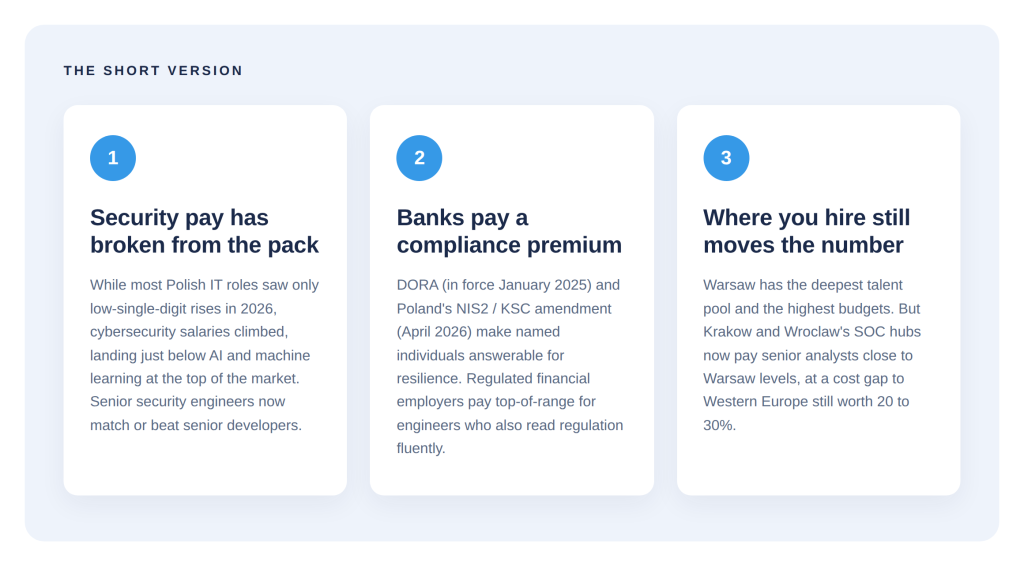
Poland’s cybersecurity pay has pulled away from the wider technology market in 2026. Where salary growth across most IT roles has settled into the low-single-digit rises described in Verita HR’s Poland Salary Guide 2026, security specialists are moving the other way, commanding premiums that now sit just below the AI and machine learning roles at the very top of the ladder. Demand is being driven by compliance hiring under the NIS2 directive and DORA, and by a talent shortage Polish universities have not closed.
For an employer placing a security team in Poland, where you hire (Warsaw, Krakow or Wrocław) and who you are bidding against (a bank, a software house or a shared service centre) now changes the number materially. This guide benchmarks security pay against Verita HR’s wider salary data, sets out what the major roles pay across the three largest markets, and explains the banking and fintech premium that most salary surveys leave out.
The 2026 Security Labour Market in Brief
The market is short of people, and the gap is still widening. ISC2’s 2024 Cybersecurity Workforce Study estimates Europe’s cybersecurity workforce gap at 392,320, up 12.8% from 347,761 in 2023. Poland feels this through its wider ICT deficit, and industry estimates still cluster around a shortage of tens of thousands of ICT specialists, concentrated in cybersecurity, cloud and AI.
Demand has a clear driver. Check Point Research consistently placed Poland among the most attacked countries in Europe in 2024, with weekly incident volumes running above the European average and on a par with the most targeted neighbours. The result, per Optima Europe, is that European cybersecurity salaries have risen 20 to 30% since 2023, with Central and Eastern European markets including Poland running 30 to 40% below Western European equivalents, a gap that is narrowing fast for remote roles.
What the Category Numbers Say
The Just Join IT Salary Report 2026, the same IT-specific source used in Verita HR’s main salary guide, reports a single Security category rather than separate SOC and offensive bands. On employment contracts (UoP) and business-to-business contracts (B2B), those category figures are:
| Security (Just Join IT category) | Junior | Mid | Senior |
|---|---|---|---|
| UoP (gross monthly) | PLN 7,500 | PLN 17,000 | PLN 24,250 |
| B2B (net monthly invoice) | PLN 12,800 | PLN 21,250 | PLN 27,300 |
No Fluff Jobs’ September 2026 cut of advertised ranges puts cybersecurity offer medians at PLN 20,000 to 25,000 gross on UoP and PLN 23,500 to 30,200 net plus VAT on B2B, the highest upper-band median since early 2024.
What Specific Roles Pay
SOC and monitoring roles sit toward the lower half of that band. Offensive engineering, penetration testing and cloud security sit toward the top of it, and often above it. Poland IT recruiter NTIATIVE puts senior security engineers at PLN 24,000 to 32,000 plus VAT on B2B, with penetration testing and cloud security roles carrying a 15 to 20% premium that peaks around PLN 42,000 a month.
A compilation of Q1 2026 data from Just Join IT, No Fluff Jobs, Glassdoor, Levels.fyi, Robert Half, Hays and Michael Page places CISOs at PLN 30,000 to 65,000 a month, and notes that a senior penetration tester in Krakow working remotely for a German or UK employer can clear the equivalent of PLN 45,000 to 55,000 while paying Polish living costs. On Levels.fyi, median total compensation for a cybersecurity analyst in Poland sits around PLN 240,000 a year. Treat that figure as a multinational, equity-inclusive package rather than a local UoP salary.
Set against Verita HR’s 2026 benchmarks, this places security firmly in the upper tier of Polish IT pay. The general IT average reported in the salary guide is around PLN 14,500 gross a month, and senior developers on B2B typically invoice PLN 25,000 to 27,000 net. Senior security engineers and offensive specialists match or beat that senior-developer band, and the offensive and cloud premium pushes the best-paid roles toward the AI and machine learning territory that tops the market.
The Banking and Fintech Premium
The same security profile does not command the same price across every employer. Banks, payment institutions and fintechs pay at the top of the range, and the reason is regulatory accountability rather than prestige.
The Digital Operational Resilience Act (DORA), applicable to financial entities across the EU since 17 January 2025 and enforced in Poland by the KNF, makes named individuals answerable for ICT and operational resilience. That turns security hiring from a discretionary spend into a compliance obligation, and it concentrates demand on a profile that is genuinely scarce: engineers who also read regulation fluently.
As Verita HR set out in its analysis of how AI is reshaping Polish banking and fintech hiring, the shortage is not raw technical skill but the hybrid candidate who pairs technical depth with governance and model-risk understanding, the combination DORA now requires. A software house hiring the same engineer is buying capability. A bank is buying capability plus assurance, and it pays for both.
City Premiums: Where You Hire Matters
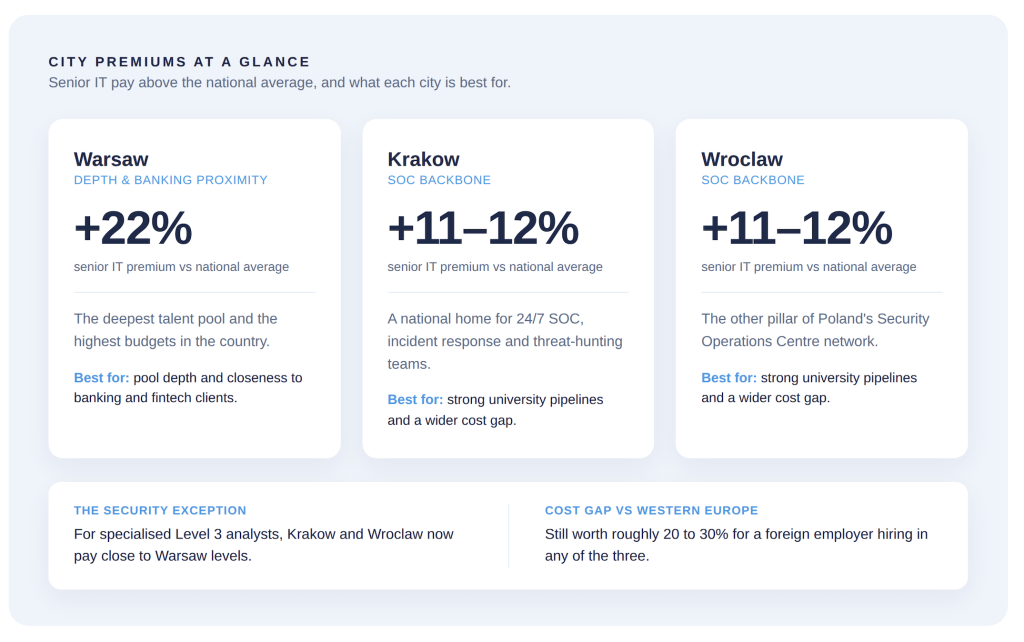
Location remains one of the largest levers on cost, though less so than in general IT. Warsaw carries the deepest talent pool and the highest budgets; the salary guide puts Warsaw’s senior IT premium at around 22% above the national average, against 11 to 12% for Krakow and Wroclaw. The same split is set out city by city here.
Security is the exception that partly closes this gap. Krakow and Wroclaw have become the country’s Security Operations Centre backbone, hosting the 24/7 SOC, incident response and threat-hunting teams of global firms. The pay for specialised Level 3 analysts in those cities now runs close to Warsaw levels. For a foreign employer the trade-off is simple: Warsaw for pool depth and proximity to banking clients, Krakow or Wroclaw for strong university pipelines and a cost gap against Western Europe still worth roughly 20 to 30%, as covered in Verita HR’s look at IT outsourcing in Poland.
What Else Is Shaping Cyber Pay in 2026
NIS2 and the KSC amendment.
Poland’s amended Act on the National Cybersecurity System, which transposes the EU NIS2 directive, entered into force on 3 April 2026.
It expands the regime from around 400 regulated entities to an estimated 42,000, with a self-assessment and registration deadline of 3 October 2026 and full implementation of obligations due by 3 April 2027.
Standard administrative fines follow the NIS2 caps; in cases that create a direct and serious cyber threat to defence, state security, public order or life and health, the Polish Act adds a fine of up to PLN 100 million. That timeline is pulling forward demand for GRC and compliance-literate security staff across energy, healthcare, digital infrastructure and manufacturing, not only financial services.
The B2B and remote lever.
The single biggest earnings driver for senior Polish specialists is remote work for Western European employers, who pay premium-to-local but below-home-market rates.
Optima Europe notes that a senior cloud security engineer might accept €80,000 to €90,000 locally but command €100,000 or more from an Amsterdam, London or Munich employer, which sets the floor domestic employers must compete against.
Certifications over tenure.
The market increasingly prices proven credentials (CISSP, OSCP, cloud security certifications) and demonstrable work such as CVE research or ISO 27001 audit history above years of general experience, a shift that rewards specialists and compresses pay for generalists.
Getting the Data Right: Verita HR’s Approach
Poland’s security salary data is fragmented across job-board reports, aggregator estimates and Western benchmarks that do not account for the DORA premium or the city-by-city SOC picture. For an employer building or scaling a security function, translating those data points into a workable compensation band requires current figures and sector-specific context, particularly the difference between what a regulated financial employer and a product company will pay for the same hire.
Verita HR places IT and security talent for banking, fintech and shared service operations across Poland. Whether the task is benchmarking a single senior hire or standing up a full security team, current placement data beats a single annual snapshot.
Verita HR’s permanent recruitment and outsourcing teams can build that comparison against live market rates.
Author: Grace Sharp
See Also:
Poland Salary Guide 2026: IT, Finance & Engineering Pay Benchmarks
Poland Salary Guide 2025: What You Need to Know
Warsaw Tech Salaries 2025: Top IT & Digital Pay Trends
A note on sources: Glassdoor’s Poland security figures rest on very small samples (its penetration tester estimate has drawn on around a dozen salaries), so they are useful only as a directional cross-check, not a benchmark.