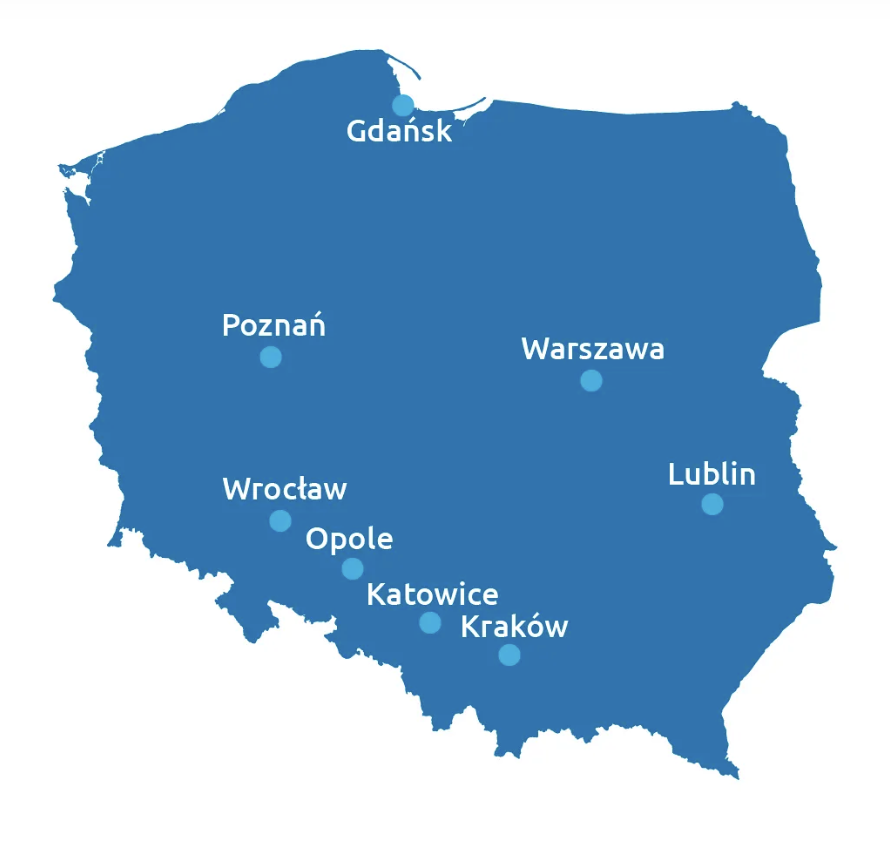
Capgemini has been in Poland since 1996, and in the years since it has grown into one of the largest employers in the country’s business-services sector, with more than 11,500 people spread across nine offices in eight cities.
The company runs everything from finance and accounting for global clients to cloud engineering and cybersecurity, which makes it one of the widest single doors into Poland’s business-services and technology sector.
For anyone weighing up a job there, the questions that matter are simple. What does it pay, what is the work, and what do the people who work there actually say? Let’s have a look.
What Does Capgemini Do in Poland?
Capgemini is not one business but several under a single name, and understanding the split is the key to reading its jobs.
The company arrived in Warsaw in 1996 and expanded hard from 2004 onwards. Today it is a flagship name in a Polish business-services sector which in total contributes 6.1 percent of the country’s GDP.
The business-services engine
The largest part is business-process services. From centres in Krakow, Katowice, Wroclaw and beyond, thousands of staff run finance and accounting, HR operations, customer service, procurement and data management for corporate clients around the world. More than 30 languages are spoken across the offices on any given day, and the Polish workforce covers 92 nationalities, because much of this work is multilingual back-office support for global companies. This is the volume employer: it is where most graduate and early-career hires land, and it is the root of Capgemini’s reputation as an entry point into corporate Poland.
The technology and engineering side
The second Capgemini is the technology business: software development in Java, JavaScript and .NET, cloud and infrastructure services, cybersecurity, and data and analytics. Alongside it sits Capgemini Engineering, the product-engineering and R&D line, which hires in Katowice and other Polish cities. These are the higher-paid, more specialised roles, and they are the part of the business Capgemini is pushing hardest as clients ask for AI and cloud work rather than raw headcount.
What Does Capgemini Pay in Poland?
Pay at Capgemini depends heavily on which of those two businesses you are in.
For software engineers, Levels.fyi puts total compensation roughly between PLN 108,000 and PLN 341,000 a year. Medians by level sit around PLN 108,000 at A3 (associate), PLN 153,000 at A4, PLN 208,000 at A5 (senior) and about PLN 341,000 at C1. The overall median clusters nearer PLN 150,000. Almost all of that is base pay: stock and bonus barely feature in the Polish submissions.

Glassdoor’s self-reported base figures tell a similar story from the bottom up: a junior software engineer around PLN 78,000 to PLN 96,000, a software engineer PLN 95,000 to PLN 144,000, and a senior engineer PLN 135,000 to PLN 212,000. Project managers land between roughly PLN 114,000 and PLN 198,000, and business analysts between PLN 72,000 and PLN 120,000.
These figures are self-reported and move with team and year, so treat them as a guide rather than a quote. What they show is the pattern you would expect from a business this broad. The floor is modest, which is what draws the criticism on pay, but the ceiling for specialist engineers and managers is competitive for Poland without matching the likes of Google or Microsoft at the very top.
Verita HR’s full salary guide is available here.
What the Reviews Say
On Glassdoor, Capgemini Poland sits at about 3.4 out of 5 from 660 reviews, with 56 percent of reviewers saying they would recommend it to a friend. That is a little below the informal benchmark for IT employers in Poland, and in line with the wider information-technology average on the platform. Krakow, the largest site, scores a touch lower at around 3.1.

The written reviews match that middling average. On the positive side, staff point to job security, strong training and the chance to work across many clients and technologies, which makes it a good place to build a CV early. Teams are described as friendly, hybrid working is common, and the benefits package (i.e. private healthcare, a sports card, a flexible cafeteria plan and paid certifications) is repeatedly called generous. Diversity and inclusion come through as a genuine strength rather than a slogan.
The complaints are consistent too: modest pay rises, progression that can feel slow, and the bureaucracy that comes with a very large organisation. Compensation is the theme that drags the score. Several reviewers describe annual increases that fail to keep pace with the market, and a sense that the company would rather replace people than re-price them. It is worth noting the sample is a fraction of an 11,500-person workforce, so read it as a strong signal rather than a full audit.
Who It Suits
Capgemini suits two kinds of person especially well.
The first is the graduate or career-changer who wants a foot in the door of corporate Poland: the services side hires at volume, values languages, and offers structured training that travels.
The second is the specialist engineer or consultant who wants exposure to large, varied clients and the backing of a global brand, and who values stability and learning over the very top of the pay scale.
It suits the pure pay-maximiser less well. If the single priority is the highest possible salary, the product companies and the international banks in Poland tend to pay more. Capgemini’s offer is breadth, security and development, and it is honest about being that rather than a top-of-market payer.
What Is Happening Now at Capgemini Poland
Globally the group is repositioning around AI and generative AI. It has been candid that this changes the mix of work it needs people for, and it has booked substantial restructuring costs, with reported cuts concentrated in higher-cost markets, above all France. No Poland-specific layoff programme has been confirmed.
In Poland, the effect looks less like cuts and more like a change in what gets hired: fewer routine process roles, more demand for cloud, data, security and AI skills, and a higher bar at interview. That mirrors the wider Polish business-services trend where employment is still growing, but only just, while exports and value per worker are rising much faster. The sector is moving up the value chain rather than simply adding seats.
For candidates, that means the services entry points are more competitive than they were, and the tech and engineering roles are where the growth is. For employers competing for the same people, it means the specialists Capgemini wants are exactly the ones everyone else wants too.
How Verita HR Can Help
For any company hiring against a name like Capgemini, the case for working with a specialist recruiter is getting stronger by the quarter. The people who can do the cloud, data and AI work are in short supply, they field several approaches at once, and a global brand is a hard anchor to bid against on name alone.
There is a second angle for firms bringing people into Poland from abroad. Capgemini leans on its scale to smooth work permits, visas and relocation for non-EU hires, and smaller employers need the same groundwork done well to compete.
Verita HR works on both sides of that: finding the specialists, including the AI talent every sector is now short of, and making the move into Poland straightforward for international candidates and the companies hiring them.
That is what working at Capgemini in Poland looks like in 2026, and for employers competing for the same people, Verita HR can help.
Author: Grace Sharp
See Also:
Working at Microsoft in Poland: Salary, Reviews and Culture (2026)
Working at Citi in Poland: Salary, Reviews and Culture (2026)
Working at Google in Poland: Salary, Reviews and Culture (2026)