
At the start of 2025, Poland’s minimum wage climbed to PLN 4,666 monthly gross (around €1,100), up from PLN 4,300 in late 2024, boosted income for low earners, but it also increased labour costs for employers.
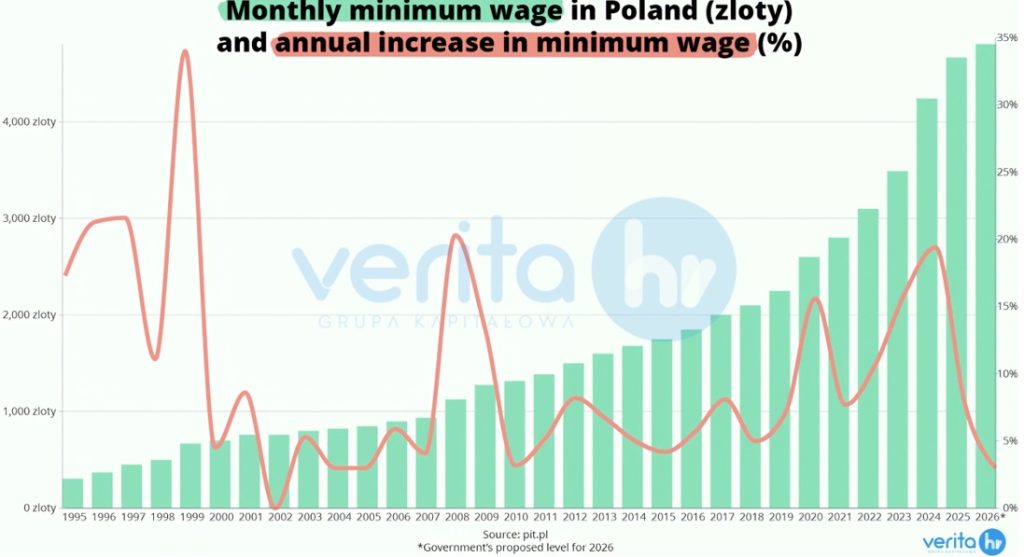
Poland has adjusted its minimum wage levels on an annual basis since 1990. The largest recent rise was in 2024 when the government raised the minimum wage by 21.5% to buffer rising inflation.
Now, with 2026 around the corner, both employees and businesses are watching closely to know what the minimum wage will be next year.
2026 Minimum Wage: A Modest PLN 4,806
The Polish government has confirmed that the national minimum wage will rise by 3% in 2026, reaching PLN 4,806 gross per month starting January 1.
After several years of sharp, double-digit increases to fight inflation, this latest bump looks modest; in fact, it’s expected to be the smallest annual raise in nearly twenty years.
The new PLN 4,806 minimum wage for 2026 is only about PLN 140 higher than this year’s rate, a sign that inflation is cooling and pay growth is slowing down to normal levels.
Unions vs. Employers: A Divide Over the Raise
Still, not everyone’s pleased. Trade unions argue the hike still falls short, saying the minimum should reach at least PLN 5,015. “This is a big disappointment,” said Piotr Ostrowski, president of the All-Poland Alliance of Trade Unions (OPZZ), arguing that the raise should keep up with the pace of average wage growth. Unions warn that a 3% uptick fails to protect workers’ “real wages amid still-elevated living costs.”
On the other hand, employer groups have described the 3% bump as a reasonable “compromise,” noting concern that the minimum wage has been rising very quickly in recent years. Jacek Męcina, an advisor to the Lewiatan business confederation, points out that a smaller hike “is more related to inflation… so it is protection of the real value of the minimum wage.”
Many businesses caution that rapidly climbing labor costs are a “major barrier to doing business” and could lead to job cuts if wage floors outpace what companies can sustain, per a letter to Prime Minister Donald Tusk by the spokesperson for the Commissioner for Small and Medium-sized Enterprises (SMEs), Agnieszka Majewska.
Beyond Wages: Impact on Benefits and Costs
Beyond the numbers, there’s an important legal shift coming with the 2026 minimum wage. Starting January 1, 2026, Poland will redefine what counts toward that threshold. Under the new law, an employee’s base pay, not bonuses or extras, must meet the legal minimum, so companies will no longer be able to rely on incentives to make up the difference. The goal is simple: make sure the minimum wage truly reflects what a worker earns for their core job, while keeping bonuses as a genuine reward for performance.
The proposed change also links the minimum wage more closely to Poland’s overall economic growth. From 2026 onward, it’s expected to equal about 55% of the national average salary (up from roughly 52% today). Backed by the Ministry of Family, Labor and Social Policy and aligned with EU standards, the new formula should help the country’s lowest earners keep pace as wages rise across the economy.
Meanwhile, Poland will continue its practice of regular adjustments: by law, the minimum wage is reviewed annually (and even updated twice a year if inflation exceeds 5%) to safeguard employees’ purchasing power. This means mid-year raises remain possible in high-inflation scenarios, as seen in 2023–2024.
Key Takeaways: What the 2026 Changes Mean
An increase in the minimum wage doesn’t just affect base pay, it cascades into other benefits. Many workplace payments in Poland are calculated based on the minimum wage.
For example, the cap on statutory severance pay in mass layoffs, compensation for workplace discrimination, or harassment, and extra pay for night shifts are all tied to the minimum wage. When the minimum rises, these amounts increase automatically, directly benefiting employees.
However, this also means employers face higher costs not only in wages but in all these linked areas. The 2025 jump to PLN 4,666, for instance, meant higher night-work allowances and a higher ceiling on severance packages.
With 2026’s rise, HR departments should review their pay structures and budgets to ensure compliance with the new base-salary rule and to account for the bump in any compensation elements pegged to the minimum.
Bottom Line
Poland’s minimum wage will rise to PLN 4,806 gross per month starting January 1, 2026. It’s a smaller jump than in past years but continues a steady climb; the minimum has now grown nearly sevenfold since 2001.
New rules coming with the 2026 rate mark a real policy shift. The minimum must now be paid as base salary, not bonuses, and it’s designed to reach 55% of the national average wage.
These changes will be felt on both sides of the table. For employers, it means rethinking pay structures and budgets. For workers, it’s another step toward fairer, more predictable earnings in Poland’s changing job market.
Do you need help understanding the intricacies of how the Polish job market works? Perhaps you are thinking of setting up a new business in Poland and need guidance? If so, get in touch with the specialists at Verita HR to find out how they can help you. Recruiting, outsourcing, or through a recruitment process outsourcing model.
Verita HR offers services including RPO | Permanent Recruitment | Outsourcing | Media Services
#MinimumWage #Poland #VeritaHR #Salaries #Pay
Author: Richardson Chinonyerem
See Also:
Poland’s Salary Law Bombshell: Why HR Must Act Now! – Verita HR