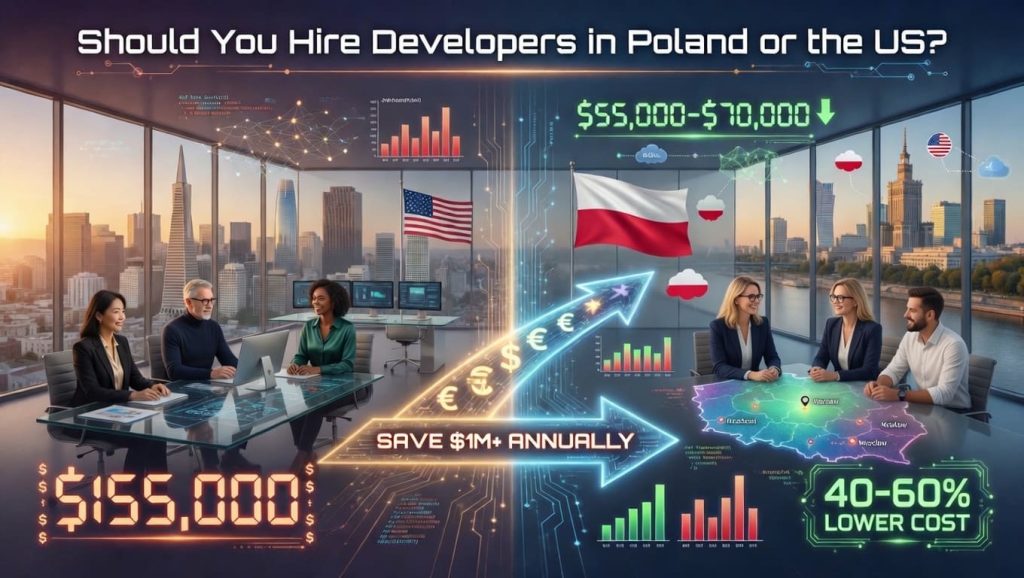
A senior software engineer in the United States costs around $155,000 + per year. The same level of experience and skill in Poland? Approximately $55,000-$70,000 per year. That’s not a typo. It’s the reality of Poland’s mature tech market in 2026, and it’s why US founders and CTOs are increasingly looking east.
But the headline numbers only tell part of the story. When deciding whether to hire developers in Poland or the US, understanding the actual savings requires looking at employment structures, total compensation costs, and what you’re actually getting for that investment. Here’s what the data shows.
The Salary Gap: Hiring Developers Poland vs US in 2026
The cost difference between US and Polish developers varies by seniority, but the pattern holds across experience levels.
Junior Developers: US salaries start around $85,000 per year. In Poland, junior developers earn between $35,000-$43,000 annually. That’s a 50-60% cost reduction right at entry level.
Mid-Level Engineers: A developer with 3-5 years of experience commands approximately $122,000 in the US market. Poland’s IT salary benchmarks show the same profile earning $55,000-$60,000. The savings here sit consistently at 50-55%.
Senior Software Engineers: This is where US compensation climbs steeply, often reaching $153,000 or higher in major tech hubs. Poland’s senior engineers earn $70,000-$89,000 depending on specialization and location. Even at the high end, you’re looking at 40-45% savings.
The cost advantage exists across all major programming languages and frameworks. Whether you’re hiring Java, Python, JavaScript, or specialized AI and machine learning engineers, Poland consistently delivers 40-60% lower salary costs compared to equivalent US roles.
B2B Contracts vs Employment: What’s the Difference?
Poland’s tech market operates on two primary hiring models, and understanding the distinction matters for budgeting.
B2B Contracts (Business-to-Business): Most experienced Polish developers prefer this structure. They operate as independent contractors, invoice monthly for services, and handle their own taxes. For US companies without a Polish entity, B2B contracts offer a clean solution. You pay the invoice, the developer manages compliance, and there’s no need for Polish payroll infrastructure.
B2B rates typically run 15-25% higher than employment contract equivalents because developers absorb tax optimization and business costs. However, they still deliver significant savings compared to US rates, and the administrative simplicity often makes this the preferred route for international employers.
Employment Contracts (Umowa o Prace): Traditional employment contracts provide more stability and control but require either a Polish legal entity or an Employer of Record (EOR) service. The developer receives a gross salary, and the employer handles tax withholdings and social security contributions (around 20% on top of gross salary).
For companies building long-term operations in Poland, employment contracts work well. For those testing the market or hiring small distributed teams, B2B typically makes more sense.
Total Cost of Employment: The Full Picture
Salary is the largest line item, but employer-side costs add to the total investment.
On employment contracts, Polish employers pay approximately 20% in social security contributions on top of gross salary. A developer earning $60,000 gross annually costs the company around $72,000 all-in.
On B2B contracts, there are no employer-side contributions. The rate you agree is the rate you pay. A developer invoicing $70,000 annually costs exactly that.
Even factoring in these additional costs, the Poland advantage holds. A senior US developer at $153,000 plus 15% in benefits and taxes ($176,000 total) still costs more than double a senior Polish developer on either contract structure.
What This Means for Your Budget
The savings scale predictably. Here’s what hiring a full engineering team looks like in practice.
10-person development team:
- US Cost: $1,530,000 (salaries) + $229,500 (employer costs) = $1,759,500
- Poland Cost (mixed B2B/employment): $600,000-$700,000
- Annual Savings: $1,050,000-$1,150,000
20-person development team:
- US Cost: $3,060,000 (salaries) + $459,000 (employer costs) = $3,519,000
- Poland Cost: $1,200,000-$1,400,000
- Annual Savings: $2,100,000-$2,300,000
These aren’t hypothetical. Companies building tech teams in Poland’s major cities consistently report these cost structures. The savings compound annually, freeing budget for product development, marketing, or extended runway.
The Quality Question
Cost savings this significant always raise the same concern: what are you giving up?
Poland ranks among the world’s top countries for developer quality. Polish engineers consistently place in the top 10 globally in coding competitions, and the country produces over 74,000 ICT graduates annually from strong technical universities. Poland’s 650,000-person tech workforce now includes significant depth in AI, machine learning, cloud architecture, and DevOps – the exact specializations US companies need most.
English proficiency is high. Poland ranks in the “very high proficiency” tier on the EF English Proficiency Index, meaning communication barriers are minimal for distributed teams. Time zone overlap with US East Coast operations provides 4-6 hours of daily real-time collaboration, significantly better than Asian outsourcing alternatives.
The talent quality concern isn’t theoretical anymore. JPMorgan, Google, McKinsey, and hundreds of other US firms already operate major engineering centers in Poland. They’re not there because it’s cheap. They’re there because the combination of cost, quality, and scalability doesn’t exist anywhere else in Europe.
How Verita HR Helps US Companies Hire in Poland
Understanding the cost advantage is one thing. Actually accessing that talent pool is another. That’s where Verita HR’s recruitment and outsourcing services come in.
Verita HR specializes in connecting US companies with Poland’s tech talent through permanent recruitment, RPO services, and full outsourcing solutions. The team handles everything from salary benchmarking and candidate sourcing to contract negotiation and onboarding logistics. For companies without Polish entities, Verita HR navigates B2B structures, EOR partnerships, and compliance requirements so you can focus on building product while they build your team.
With over 15 years in Poland’s market, Verita HR knows which cities offer the best cost-to-quality ratios, how to structure competitive offers that actually close candidates, and how to avoid the hiring mistakes that cost US companies months of lost time. If you’re considering Poland as a strategic hiring location, get in touch with Verita HR to discuss your specific needs and timeline.

See Also:
AI Talent Race in 2026: Rethinking Recruitment in Europe
Where to Hire in Poland? 2026 City Salary Guide
Poland Salary Guide 2026: IT, Finance & Engineering Pay Benchmarks