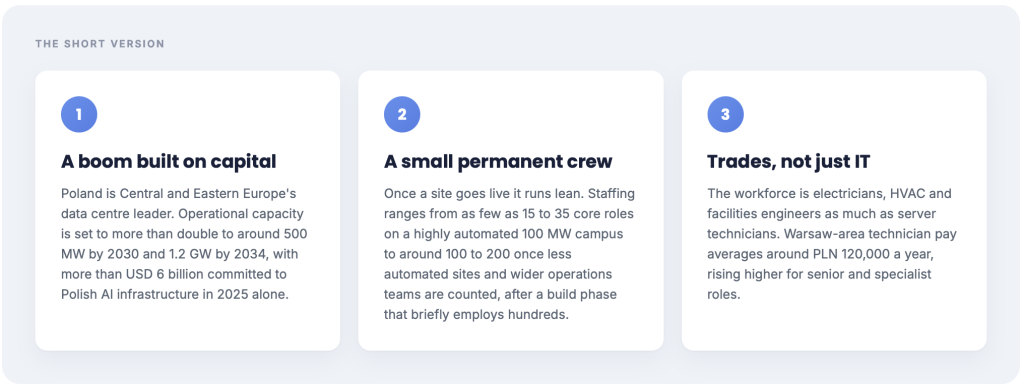
Poland is clearly in the middle of a data centre boom. The country is the data centre leader in Central and Eastern Europe, operational capacity is set to more than double by 2030, and more than six billion dollars of hyperscaler and enterprise money was committed to Polish AI infrastructure in 2025 alone. The harder question, and the one that really matters for anyone hiring or planning around these sites, is what all that concrete and power actually means for jobs.
A data centre creates two very different workforces. One is large, well paid and temporary: the electricians, fitters and commissioning crews who build the shell and fit it out. The other is small, specialised and permanent: the technicians and facilities engineers who keep it running once the servers are live. Confuse the two and the job count looks either inflated or tiny. This is a look at who staffs Poland’s data centres in 2026, what they earn, and how many jobs the boom really creates.
How Big Is Poland’s Data Centre Boom?
Poland already hosts around 61 operating colocation data centres, with Warsaw accounting for roughly half of them. Operational capacity sits at about 200 megawatts in 2026, but the forecasts are steep. Projections from CBRE and Poland’s data centre association point to around 500 MW by 2030 and 1,200 MW by 2034, and a JLL report reaches similar conclusions.
The money behind that is substantial. Microsoft has committed around PLN 2.8 billion (about USD 700 million) to expand its cloud and AI capacity, its largest hyperscaler project in the country to date, and both Microsoft and Google now run cloud regions near Warsaw. New build is spreading beyond the capital to Krakow, Wroclaw, Gdansk, Poznan and Lodz, and the Ministry of Digital Affairs has earmarked Poznan and Krakow for AI-focused supercomputing facilities. The concentration still sits around Warsaw and its industrial belt, from Duchnice and Jawczyce to Piaseczno and Blonie, which is where most of the current hiring is too. A wider list of upcoming Polish sites shows the same pattern.
Who Actually Works in a Data Centre?
The first thing that surprises people looking at Polish data centre vacancies is how little of the work is what most would call IT.
A live scan of the Warsaw market shows demand spread across server technicians, structured cabling specialists, electrical technicians working on UPS and switchgear, mechanical and HVAC engineers handling precision cooling, and facilities engineers running BMS, SCADA, generators and fire suppression. Server and network roles sit alongside genuinely different skilled trades.
That mix matters, specifically for hiring. A data centre is a critical-facilities operation first and a computing site second, so its workforce looks more like advanced manufacturing or utilities than a software team. The table below sets out the main role bands and how visible each is in current Polish vacancies.
| Role band | What the work involves | Vacancy evidence |
|---|---|---|
| IT / data centre technician | Servers, racks, structured cabling and switches | Strong |
| Senior technician | Complex deployments, commissioning and troubleshooting | Strong |
| Electrical technician | Power distribution, UPS and switchgear | Strong |
| Mechanical / HVAC | Precision cooling, chillers and air handling | Strong |
| Facilities engineer | BMS, SCADA, generators and fire suppression | Strong |
| Network engineer | Switching, fibre and connectivity | Strong |
| DCIM analyst | Asset, capacity and environmental monitoring | Emerging |
| Data centre manager | Operations, people and contractor coordination | Present |
| Physical security | Access control and site security | Essential |
| Construction / commissioning | Build-out of new facilities | Large but temporary |
Employers including AMD, Atman, Equinix, ENGIE, Fujitsu and Scalo are all recruiting across these bands in and around Warsaw, and the balance of a site’s headcount leans heavily toward trades and facilities engineering rather than pure IT.
What Data Centre Jobs Pay in Poland
Pay for these roles is solid by Polish standards and modest by Western European ones, which is much of the point for operators choosing Poland. ERI SalaryExpert puts the average data centre technician salary in Warsaw at around PLN 120,200 a year, rising from roughly PLN 88,200 at entry level to about PLN 136,800 for senior technicians.
Microsoft’s own published Poland bands for data centre technicians run from PLN 98,200 to PLN 138,000 at its ATR-B grade and PLN 121,700 to PLN 175,400 at ATR-C.
| Role | Typical annual pay (PLN) | Source basis |
|---|---|---|
| Data centre technician, entry | around 88,200 | ERI SalaryExpert, Warsaw |
| Data centre technician, Warsaw average | around 120,200 | ERI SalaryExpert, Warsaw |
| Data centre technician, senior | around 136,800 | ERI SalaryExpert, Warsaw |
| Microsoft technician, ATR-B band | 98,200 to 138,000 | Microsoft published Poland bands |
| Microsoft technician, ATR-C band | 121,700 to 175,400 | Microsoft published Poland bands |
However, it should be noted that contract structure complicates any comparison. Many hands-on roles are advertised on B2B terms rather than employment contracts: one Warsaw data centre technician posting quoted PLN 100 to 120 net per hour plus VAT on B2B, which is not directly comparable with an employee salary once tax, holiday and employer costs are stripped out. These figures are self-reported or survey-based and move with employer, grade and year, so they are a guide rather than a quote.
How Many Jobs Does a Data Centre Really Create?
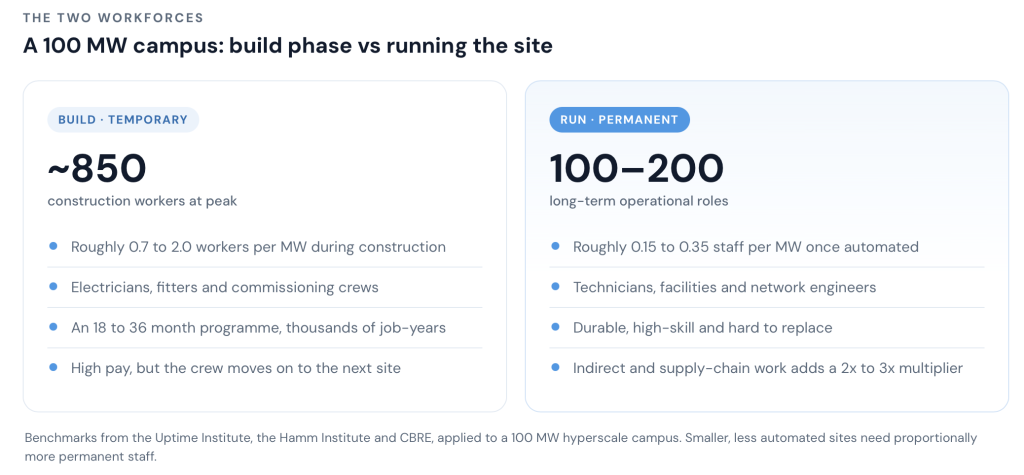
International benchmarks, which Poland’s own sites broadly track, put construction at somewhere between 0.7 and 2.0 workers per megawatt, with large builds peaking at several hundred workers on site and thousands of job-years rotating through over an 18 to 36 month programme. Industry summaries of the Uptime Institute’s figures put a 100 MW hyperscale campus at roughly 850 construction workers across an 18-month build. Those two construction estimates do not use the same method, so they should be read as a range rather than a single number.
Operations are a different story. Once a site is live, staffing runs lean. The same US analysis benchmarks put operations at about 0.15 to 0.35 full-time equivalents per megawatt at automated hyperscale campuses, which is 15 to 35 permanent roles on a 100 MW site.
Other industry figures, including those circulated from the Uptime Institute, put a 100 MW hyperscale campus closer to 100 to 200 permanent roles. Smaller, less automated enterprise sites need proportionally more people. Add the indirect effect, the supply-chain, maintenance and local-services work around a site, and analysts commonly apply a multiplier of two to three times direct employment.
The holistic reading, backed by recent Brookings research, is that data centres do create local jobs but fewer than boosters claim, and hyperscale campuses generate more of the surrounding ecosystem than colocation shells that lease space to remote tenants. For Poland that means the headline capacity numbers translate into a large but time-limited construction boom and a smaller, durable base of high-skill operational jobs.
Why the Workforce Numbers Matter for Employers in Poland
For employers, the useful signal in all this is timing and scarcity. Operators staff up before a building fills, not after: Atman launched the first phase of its WAW-3 campus in September 2025 and had already hit high pre-lease rates on an earlier site before opening, the kind of occupancy that pulls hiring forward. The people who can commission a UPS system, tune precision cooling or run a BMS are not abundant, and they are being courted by the same hyperscalers driving the build.
That scarcity overlaps with a wider squeeze. Poland is already short of technology talent, with the AI investment cycle pushing demand for AI and machine-learning engineers well past supply, and the companies closing that gap are the same names hiring into data and infrastructure. Data centre operators are competing for skilled trades and facilities specialists in a market where Warsaw tech pay already carries a premium, as Verita HR’s Poland salary guide sets out. Employers planning a site, or staffing one, are effectively hiring against Microsoft, Google and Equinix for the same shortlist.
Verita HR works with employers building and scaling technical operations across Poland, from data and analytics teams to the trades and facilities specialists that critical infrastructure depends on. For companies weighing a Polish site or trying to staff one, getting the workforce plan right early is what separates a smooth build from an expensive one. To plan your hiring around Poland’s data centre workforce, get in touch with Verita HR.
Author: Grace Sharp