Citi runs one of its largest service and technology operations out of Poland, and in 2026 that operation is sharpening its focus rather than shrinking.
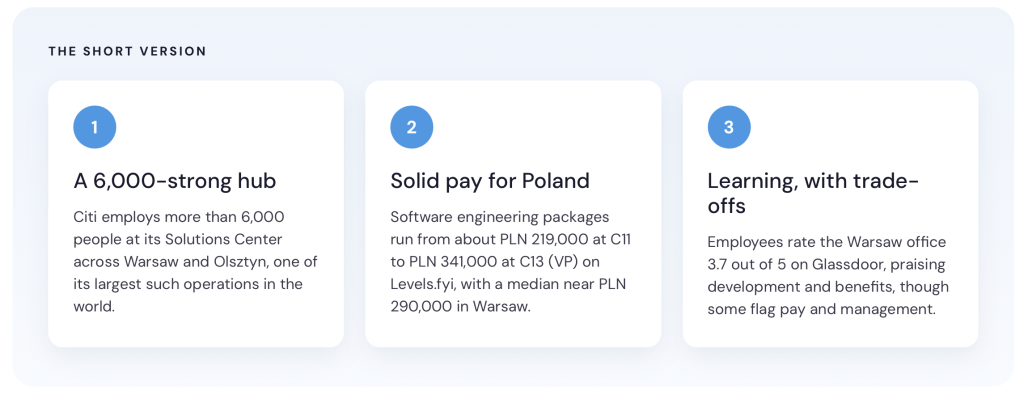
Citi has been in the country since 1991. Today that presence is two things: Citi Handlowy, the listed institutional bank in Warsaw, and Citi Solutions Center, a 6,000-person hub in Warsaw and Olsztyn that supports Citi businesses in 96 countries.
For anyone weighing up working at Citi in Poland, three questions matter. What does it pay, what is the work, and what do the people who work there actually say. Here is the picture in 2026.
What Does Citi Do in Poland?
Citi in Poland is two operations, not one.
Citi Handlowy is the listed bank at Senatorska 16 in Warsaw. Founded as Bank Handlowy in 1870, it has been part of Citi since the 2001 merger and now focuses on institutional clients after selling its consumer business to VeloBank in June 2026.
Citi Solutions Center Poland (Citibank Europe plc) is the global services and technology hub. It opened in 2005 with 57 people and now employs more than 6,000 in Warsaw (Prosta 36) and Olsztyn (Centaurus), supporting technology, operations, risk, compliance and markets for Citi businesses in 96 countries.
Most “working at Citi in Poland” searches are about the hub. The pay, reviews and hiring below follow that split.
The work is core rather than peripheral. Citi Solutions Center teams in Poland handle technology, cybersecurity, anti-money laundering, markets and securities services, treasury and trade, risk and internal audit for Citi entities, with the bank noting that roughly 5 trillion dollars moves through its global network each day.
The hub is also building AI and automation into that work, with dedicated AI and DevOps engineering roles advertised in Warsaw.
What Does Citi Pay in Poland?
Pay is strong for the Polish market and sits below the top technology names for the same level. On Levels.fyi, total software engineering packages in the Warsaw area run from roughly PLN 219,000 at C11 to about PLN 258,000 at C12 (AVP) and PLN 341,000 at C13 (vice president), with a median near PLN 290,000 and the highest reported package around PLN 411,000.
These figures are self-reported and move with team and year, so treat them as a guide rather than a quote.
What they show is a bank that pays competitively for Poland without matching the likes of Google or Microsoft at the very top. Verita HR’s full salary guide is available here.
These figures are Citi Solutions Center technology roles in Warsaw, not Citi Handlowy.
What the Reviews Say
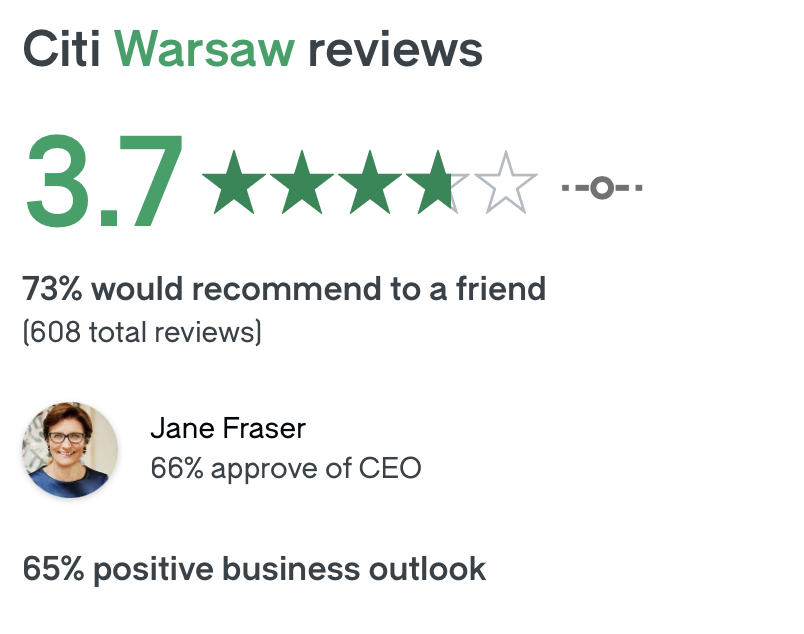
Employees in Warsaw rate the office around 3.7 out of 5 on Glassdoor, from just over 600 reviews, with about 73% saying they would recommend it to a friend. The score is in line with the financial-services average and with Citi worldwide. Diversity and inclusion scores higher at around 4.1, while pay and benefits sit near 3.5.
The positives are also pretty consistent. Reviewers describe strong development opportunities, genuinely international work, and a solid benefits package that includes private medical cover, a 6% defined-contribution pension (PPE), life insurance, paid parental leave, a sport card and hybrid working of up to two days from home.
The criticisms are just as familiar for a large bank. Some point to favouritism and uneven management, others to budget cuts trimming benefits and to pay that, in certain roles, trails the wider market. None of it is unusual for a global bank running a large lower-cost hub, but it is worth knowing before signing.
Glassdoor’s Poland score is dominated by Solutions Center staff in Warsaw and Olsztyn.
Who It Suits
Citi in Poland rewards people who want international scale, a structured career path and the chance to move across risk, technology, operations and markets without changing employer. Technology, cybersecurity and AI-automation specialists have the most to gain as the hub leans further into engineering.
Those chasing the very top of the pay scale, or a flat startup culture, will feel the limits of a large corporate bank. For most professionals in Poland, though, Citi remains one of the steadiest and most international places to build a career.
What Is Happening Now at Citi Poland
Citi’s Polish story in 2026 is one of focus. In June the bank completed the sale of Citi Handlowy’s consumer business to VeloBank, moving around 1,600 retail staff and leaving Citi Handlowy to concentrate on institutional banking, which already generated more than 70% of its revenue. Head of international, Ernesto Torres Cantú, said this about the development:
“Poland remains a critical institutional market for Citi and we are immensely proud of Bank Handlowy’s 156-year history and of our people there. This transaction sharpens our focus, allowing us to enhance our institutional businesses and better connect corporations in Poland to our global network.”
That focus runs alongside continued investment in the service centre, where Citi has kept hiring in technology, risk and AI even as the retail arm moved on. For engineers and operations specialists, the hub, not the high street, is where Citi’s Polish future now sits.
How Verita HR Can Help
For any company hiring against names like Citi, the case for working with a specialist recruiter gets stronger by the quarter. Warsaw and Olsztyn are no longer the cheap option in European banking and technology. They are where the sector now competes hardest for people.
Verita HR helps employers find and keep the technology, risk and operations talent that firms like Citi are chasing across Poland, including the AI specialists every sector is now short of. That is what working at Citi in Poland really looks like in 2026, and for employers competing for the same people, Verita HR can help.

See Also:
Working at Google in Poland: Salary, Reviews and Culture (2026)
Working at Goldman Sachs in Poland: Salary, Reviews and Culture (2026)
Working at Revolut Krakow: Culture, Reviews & Work-Life Balance (2026)