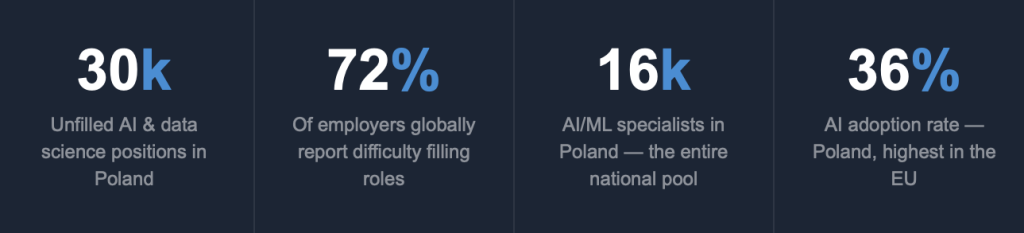
Poland is sitting on a structural time bomb. There are roughly 30,000 unfilled AI and data science positions in the country right now. That figure does not capture the roles companies haven’t yet created because they can’t fill the ones already open.
In today’s story we look at three of the companies trying to push the AI charge in Poland: ING, Vecten and Fortrea.
AI Skills: Now the World’s Toughest Talent Shortage
For the first time ever, AI skills have topped the global talent shortage rankings. ManpowerGroup’s 2026 Talent Shortage Survey, which covered 39,000 employers across 41 countries, found that 72% of employers now report difficulty filling roles. Poland’s headline figure of 57% looks less alarming on paper. But that number masks a critical distortion: it covers all sectors. Zoom in on AI and data roles specifically, and the picture is far more acute.
According to a Verita HR’s latest analysis, Poland has just over 16,000 AI/ML specialists nationwide, with 6,400 concentrated in Warsaw. That is the entire pool, and companies from banking, fintech, pharma and consultancy are all competing for that same narrow cohort.
Around 62% of organisations globally struggle to hire Machine Learning engineers. In Poland, the pipeline is strong in theory but light on experienced mid-and senior-level talent who can deliver production-ready models at scale. It is not a market that lacks interest. Instead, it lacks people who’ve done it before.
Salary pressure confirms the squeeze. Senior AI/ML roles in Poland now command between 24,000–28,000 PLN per month. That is the market signal companies are responding to. Three of them have been particularly direct about what they are changing and why.
ING Hubs Poland: 90% Pilot-to-Production (vs Industry 30%)
ING Hubs Poland (previously ING Tech Poland) has operated from Katowice and Warsaw since 2003, providing IT and operational services to ING units globally. What has changed is the ambition of what that hub now delivers. Over the last ten years the hub became far more visible when it started to engage quantitative analysts and developers both from the local as well as the national job market. This was a significant achievement as normally these talented individuals centred around cities like Warsaw, Krakow and to a limited extent Wroclaw. Katowice has little to no background in engaging talent like this, until ING Hubs Poland came along.
ING’s tech division is not simply hiring quantitative analysts anymore. Today it is looking for AI engineers too. To support this push, it is reengineering how AI moves from experiment to production. Its centralised AI platform, which governs all GenAI and machine learning development across the group, moves 90% of pilot projects into full production. The industry average is 30%. That gap is not luck, it is the result of a deliberate architecture decision that connects data, risk, and engineering teams from day one.
In practice, this shapes ING’s approach to hiring in Poland. Open roles like Senior Machine Learning Engineer and Lead ALM Risk Model Development are not standalone positions. They feed into a Centre of Excellence in Analytics Engineering that spans credit scoring, anti-money laundering, and retail banking ML solutions.
When ING says it is building GenAI capabilities in Poland, it means it. ING has already trained 5,000 employees on data fluency and GenAI, and its customer-facing GenAI chatbots, built in partnership with McKinsey’s QuantumBlack, now automate 75% of customer queries across multiple markets. The first pilot alone, rolled out in seven weeks, helped 20% more customers than the previous system within its first weeks of use.
What has the talent gap forced ING to change? The bank has moved toward a platform-first model: rather than searching for enough AI talent to build bespoke solutions market by market, it builds centralised tooling that a smaller pool of senior engineers can operate at scale. Poland is central to this. The ING Hubs Warsaw team sits inside that production loop, not on the periphery of it. The Senior DevOps Engineer and ALM Senior Business Analyst roles currently open in Katowice and Warsaw reflect the same logic: ING needs engineers who can build for scale, not just prototype.
Some of the key people leading the teams at ING Hubs Poland include Przemek Furlepa, the Head of ING Hubs Poland, Lukasz Miedzinski, Global IT Lead focused on cybersecurity, Maciej Ziolkowski, Product Lead Google Cloud Platform – AI Journeys, and more recently Arkadiusz Lapinski, Global Head of SOC. Other key members of the team include Jakub Cerny and Grzegorz Kamzol, who are both Chapter Leads of quant teams at ING Hubs Poland.
Vecten: From Building Websites in 2010 to AI-Native Engineering Today
Vecten’s trajectory is a case study in what the talent shortage forces a consultancy to become. The Warsaw-based data infrastructure firm started building websites in 2010. It is now operating as a high-end AI and machine learning engineering consultancy, delivering AI-native data infrastructure to clients who cannot build these teams internally. The company’s evolution is not marketing, it reflects where client demand has moved.
Vecten’s biggest hiring pain points tell the real story: senior data engineers, machine learning engineers, data scientists, and cloud platform engineers. These are the same profiles every company in Warsaw is chasing. Vecten’s response has been to position itself as the destination rather than the competition, hiring engineers who want to work across multiple high-complexity AI projects rather than owning a single internal roadmap. Open roles including AI-Native Engineer and Senior Data Engineer (DBT, Airflow, Snowflake) reflect this: they require broad stack experience and the ability to deliver end-to-end, not just code to spec.
The talent shortage has also shaped Vecten’s client model. Companies that cannot hire a senior ML engineer outright are increasingly turning to firms like Vecten to embed that capability without the acquisition cost and timeline. This is the consultancy-as-infrastructure play, and it is growing fast in Warsaw. Data and analytics roles overtook JavaScript as the most-listed category on Poland’s job market in 2025, reaching 11,364 listings. Vecten is competing in that market directly, and deliberately.
Lukasz Karwacki leads the team in Poland and was recently in attendance at 0100 in Amsterdam where investors meet to discuss challenges. Przemek Lewandowski is the CTO at the company, while Mateusz Klimek is a Staff Data Engineer who looks after open source data quality amongst other things.
Fortrea Warsaw: Clinical Trials Now Need Elite Coders, Not Just Scientists
Fortrea is a global contract research organisation (CRO) with over 30 years of clinical development experience and more than 15,000 employees worldwide. Its Warsaw presence reflects a broader trend in life sciences: the sector is discovering that its most acute hiring problem is more of a shortage of engineers who understand clinical data than a shortage of scientists. Fortrea presented at the J.P. Morgan Healthcare Conference in January 2026, an event that concentrates the sharpest institutional capital in the healthcare sector. The message was clear: clinical research is becoming a data and technology business as much as a science one.
The roles Fortrea is hiring for in Warsaw confirm this. A Senior or Principal Statistical Programmer (Oncology) is someone who can build and validate the statistical pipelines that determine whether a cancer drug clears regulatory review, not a data analyst. A Director of Data Integration and a Senior Biostatistics Manager for Real-World Evidence in Europe round out the picture. These are not entry-level technical roles. They require domain expertise in clinical methodology combined with production-grade data engineering. That combination is rare anywhere. In Poland, it is exceptionally hard to source.
What has the shortage forced Fortrea to change? Its Warsaw hiring strategy has become markedly more specific about what it will and won’t compromise on. The Senior Director of Enterprise Architecture role, Fortrea’s most senior architecture leadership position, reflects how seriously the company is investing in its Polish technical infrastructure. It is not outsourcing commodity work to Warsaw. It is placing strategic leadership there.
In a market where ICT vacancies in Poland run 275% higher than the national average for all jobs, that level of commitment demands a competitive employer value proposition. And Fortrea’s early career internship infrastructure in Poland suggests it is investing in building the pipeline it cannot yet hire directly.
The Polish office of Fortrea hosts various director-level and specialist positions in clinical operations, data, cybersecurity, automation, and change management. These typically report into global or European functional leads rather than a single high-profile “Country Manager” for the entire entity.
Some of the key people leading the teams in Poland include Arkadiusz Kaczmarczyk, Senior Director – Cybersecurity, Strategy & Transformations, and Anna Swiatanska, Head of EMEA Project Management.
The Smartest Companies Aren’t Waiting for Poland’s AI Gap to Close
Poland’s AI talent gap will not close quickly. The global shortage is projected to persist through 2030, with demand outstripping supply by more than 3:1 in key roles. Only 22% of Polish IT graduates specialise in data science or machine learning. The pipeline is growing, but it is growing slower than the demand curve. Poland’s AI adoption rate of 36%, the highest in the EU, means the demand side is accelerating even as supply struggles to keep pace.
What ING Hubs, Vecten and Fortrea have in common is not a single solution. What they have in common is a refusal to wait for the market to fix itself. ING Hubs is centralising AI infrastructure so fewer people can do more. Vecten is building a consultancy model that absorbs talent the market hasn’t priced yet. Fortrea is placing senior strategic leadership in Poland rather than treating it as a back-office location.
These are three different industries making three different bets, but they are all reading the same signal: the companies that build talent strategies for this environment today will have a structural advantage that competitors cannot replicate quickly. The ones that wait are already behind.
Where Verita HR Fits In
Verita HR sits at the intersection of these three challenges. As a specialist recruitment and HR consultancy operating across Poland, the team works with companies navigating exactly the dynamics described above: a shallow senior talent pool, long time-to-hire for specialist roles, and growing pressure to build teams that didn’t exist in most organisations three years ago.
For companies like those profiled here, the question is rarely whether to hire. It is how to move faster and more precisely than the competition. That is where Verita HR can help. If the talent challenges facing your organisation look anything like what is described in this piece, the team would welcome the conversation.

See Also:
The Real Cost of an Unfilled AI Role in Poland 2026
AI Talent Race in 2026: Rethinking Recruitment in Europe
How Did Poland Become Europe’s Economic Miracle and a Magnet for Top Global Talent?