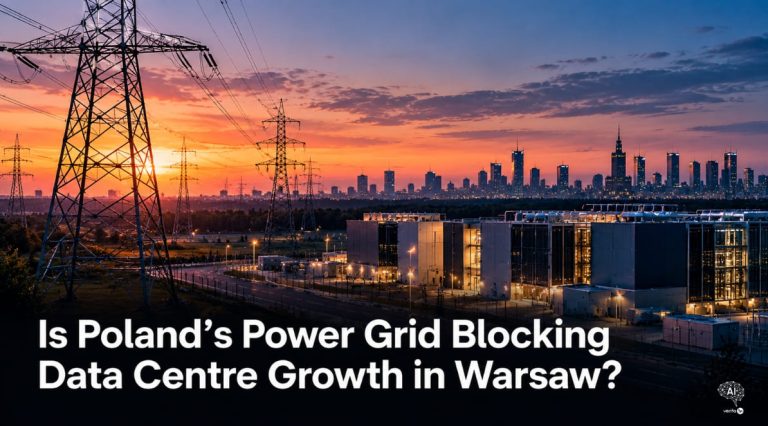
At GTC Berlin this week, NVIDIA is putting grid operators on the AI infrastructure stage. TenneT, Bayernwerk, Siemens Energy and Schneider Electric are all represented on panels about power demand and grid reliability. That is the constraint between an AI build-out and the electricity to run it. The utilities on stage are German and Dutch. Poland was not among them. Finance minister Andrzej Domański has said the country holds more than a third of data centre capacity in Central and Eastern Europe.
That absence is worth correcting. Poland’s numbers are more interesting than the ones being discussed in Berlin.
How Much Electricity Do Poland’s Data Centres Actually Use?
Poland generated roughly 174 TWh of electricity in 2025. Gross domestic consumption was 175.2 TWh. Renewables reached a record 54.7 TWh, or 31.4% of generation. In June 2025, output from renewables exceeded coal for the first time.
No single operator will disclose how much power the country’s data centres actually draw. What is published is installed or contracted IT load, which is a different thing. At DCN Warsaw this month, the chief executives of Equinix Polska, Beyond.pl and Atman put Poland at roughly 140 facilities totaling around 200MW. Against the roughly 103 GW of global capacity JLL counted at the start of this year, that is roughly 0.2 percent. Poland holds more than a third of the capacity in its own region and barely registers globally.
Two numbers circulate for Poland and both are right. Colocation capacity is around 200 MW. Counting enterprise and internal facilities, bank data halls and telco sites included, the installed base is closer to 700 MW. For someone in a planning role the first number matters. For anyone hiring, the second one does. A captive server room needs the same certified electrician as a hyperscale campus.
Poland’s Data Centre Connection Queue Is Three Times What’s Built
The reason data centres are affecting the electricity grid so much in Poland today is not consumption. It is the ratio between what is connected and what has been asked for.
At the end of 2025, roughly 157 MW were actually connected in the Warsaw area, while contracted connection requests already exceeded 0.5 GW. Three times more requested than built, in the one metropolitan area that holds about 80% of the country’s capacity.
The pipeline behind that queue is substantial: a 260 MW project announced for Konin, up to 200 MW at Bielsko-Biała, Beyond.pl’s 150 MW campus in Poznań, Switch’s 100 MW-plus development at Mory west of Warsaw, Data4’s Jawczyce campus heading to 60 MW, and Atman’s WAW-3 targeting 43 MW. CBRE counts around 60 projects across Poland at various stages, ranging from tens of megawatts to more than a gigawatt.
The Polish electricity grid operator, PSE, has been analysing the demand for new data centres. It plans to invest approximately €15 billion in the grid through 2034, against a demand forecast that rises to 194 TWh by 2030 and 264 TWh by 2040. Increases of 11% and 60% on 2025.
Why Poland’s Data Centres Cannot Hire Foreign Electricians
A grid connection is a permitting and capital problem, and Poland is solving it at the usual pace. Bringing a site into service is a workforce problem, where Poland is still behind.
Every megawatt in a new pipeline needs electricians who can work on live medium-voltage systems. In Poland that requires SEP qualification, issued by qualification commissions appointed by the President of the Energy Regulatory Office and valid for five years. A UK 18th Edition, a German Meisterbrief or a US journeyman certificate does not transfer. A foreign technician cannot step onto a Polish data centre floor on day one, whatever their experience.
The shortage of specialists is already measurable. Equinix’s own polling found 33% of data centres short of electricians and 30% short of mechanics. And these people are not only being hired by data centres. PSE’s €15 billion grid programme, Poland’s renewables build-out, storage projects and nuclear preparation are all competing for the same electricians, automation technicians and commissioning engineers.
Salary levels reflect the shortage. A Warsaw data centre technician sits in roughly the same band as an HVAC technician, around 120,000 to 140,000 złoty per year, with senior data centre technicians near 136,800 and operations managers closer to 188,000 on ERI’s 2026 figures.
What the Connection Queue Means for Hiring in Poland
Two things. Poland’s data centres are currently a negligible load on the national grid. And the sector is nonetheless on a trajectory that PSE has had to build a €15 billion plan around.
Between those two facts sits the factor that will determine how much of the pipeline gets built: whether there are enough certified people to energise it. Capital is available. Land is available. Grid capacity is being built. The electricians are the queue inside the queue.
Verita HR works with employers building and staffing technical operations across Poland, including the electricians, HVAC and commissioning specialists a data centre cannot open without. If you are planning a Polish site or trying to fill an electrical vacancy in one, get in touch.
Author: Andy Samu
See Also:
What is an SEP Certificate, and Why Poland’s Data Centres Cannot Hire Without it – Verita HR
Who Is Already Hiring Data Centre Facilities Staff West of Warsaw? – Verita HR