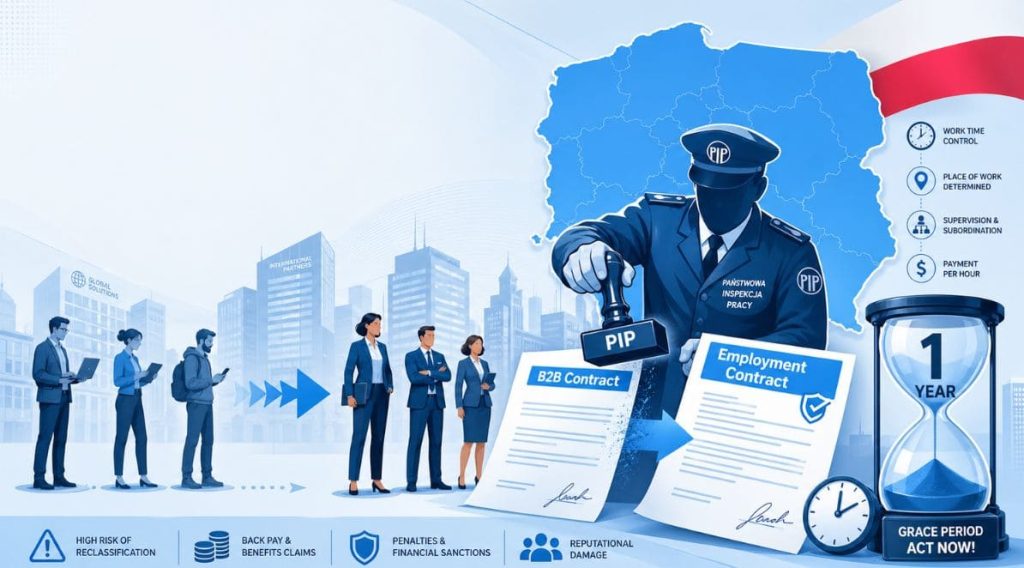
Poland has significantly expanded the authority of its State Labor Inspectorate (Panstwowa Inspekcja Pracy, or PIP), giving inspectors new powers to reclassify business-to-business (B2B) contracts as employment relationships. For international companies operating in Poland with independent contractors, this reform requires immediate attention to contract structures and working arrangements.
What’s Changing in Poland’s 2026 B2B Laws
Under the newly signed legislation, labor inspectors can now formally determine that an employment relationship exists even when parties have signed a civil law contract, such as a freelance agreement or B2B arrangement. This isn’t just an administrative finding: inspectors can mandate specific employment terms including job duties, work location, and working hours.
The process works in stages. If an inspector identifies a potential misclassification during a workplace inspection, they’ll first order the company to convert the arrangement to an employment contract. Only if the company fails to comply can the inspector issue a binding determination establishing the employment relationship and its terms.
The One-Year Window
The reform includes a transitional provision that international companies should note carefully. Businesses currently using civil contracts in circumstances that may constitute employment have one year to bring arrangements into compliance voluntarily. Companies that convert questionable B2B relationships to proper employment contracts within this period will avoid financial penalties, which can reach 60,000 PLN per violation.
This grace period recognizes that many existing arrangements evolved without intent to circumvent labor law. However, it also sets a clear deadline for action.
What Triggers Scrutiny
Labor inspectors will evaluate multiple factors when assessing whether a B2B relationship is actually disguised employment. The key risk areas include:
Time and attendance: Contractors required to work specific hours, coordinate all absences in advance, or justify non-working days with documentation face high risk of reclassification. True independent contractors control their own schedules, though they may need to coordinate availability for project needs.
Compensation structure: Payment calculated by the day or hour, rather than for completed services or deliverables, signals an employment relationship. A contract stating “compensation per day (minimum 8 hours)” is particularly problematic.
Location requirements: Mandatory presence at company premises without clear project justification raises red flags. While some roles legitimately require on-site work (such as handling sensitive data) blanket requirements for office attendance suggest employee status.
Supervision and direction: Contractors who receive ongoing instructions about how to perform work, cannot decline assignments, or report to supervisors within the company structure look like employees regardless of contract labels.
Economic risk: Employees work for guaranteed compensation with the employer bearing business risk. Independent contractors should bear some economic risk for their services and maintain responsibility for their own business expenses.
How At-Risk Is Your B2B Arrangement?
Now that you understand what triggers scrutiny, use this tool to assess your current contractor relationships:
The “Will of the Parties” Won’t Protect You
A critical provision in the reform explicitly limits the relevance of what the parties intended. Inspectors will consider the stated intent to create a contractor relationship only “if it is not contrary to the law, in particular the provisions of labour law or the principles of social coexistence, or does not seek to circumvent the law.”
In practice, this means even a clearly documented agreement between company and contractor to maintain a B2B arrangement provides no protection if the actual working conditions resemble employment. Mutual preference for contractor status is irrelevant when the work is performed under employment-like conditions.
Individual Interpretations: Limited Protection
The reform introduces a mechanism for requesting individual interpretations from the Chief Labor Inspector about whether a specific arrangement constitutes employment. While this sounds helpful, companies should understand its limitations.
These interpretations aren’t binding on the company, and crucially, the PIP can deviate from its own interpretation if actual circumstances during an inspection differ from those described in the request. Even with complete good faith, discrepancies can arise. For example, a company might consider shared use of company uniforms insignificant, while an inspector views it as evidence of subordination.
Practical Steps for International Companies
Companies with B2B contractors in Poland should act now:
Audit existing arrangements: Review contracts and actual working conditions for all B2B relationships. Focus on the high-risk factors: hourly compensation, attendance requirements, fixed schedules, and direct supervision.
Revise contract language: Remove employment-like terminology such as “failure to show up,” “days off,” or references to specific working hours. Emphasize project deliverables, contractor independence, and business-to-business nature of the relationship.
Align practice with contracts: Written terms mean nothing if daily reality shows employee-like conditions. If contractors work fixed hours in your office under direct supervision, the contract structure is vulnerable regardless of language.
Consider genuine conversions: For roles that legitimately require employment-like conditions (fixed schedules, direct supervision, on-site presence) conversion to proper employment may be the appropriate solution, particularly during the grace period.
The reform reflects broader European scrutiny of platform work and contractor classification. International companies operating in Poland should treat this as an opportunity to ensure their contractor relationships are genuinely independent in both form and substance, not just a compliance burden to manage.

See Also:
Poland’s Salary Law Bombshell: Why HR Must Act Now!
Poland Salary Guide 2026: IT, Finance & Engineering Pay Benchmarks