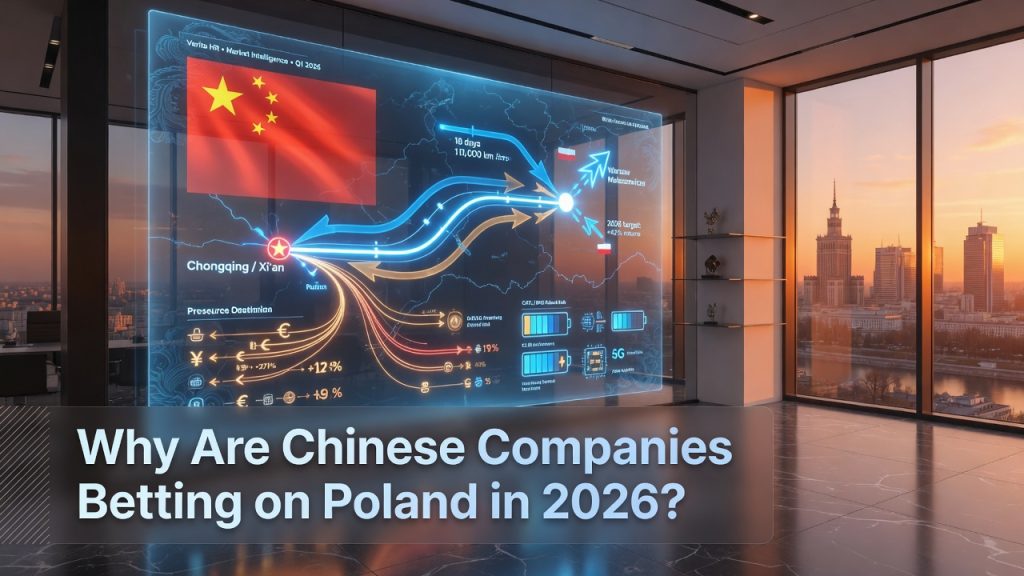
Scroll through Chinese social media platforms like RedNote and you’ll see the same message repeated: “波兰这个窗口期真的不能再错过了” (“This window of opportunity in Poland really can’t be missed”). From HR service providers to business consultants, everyone is pointing Chinese companies toward Poland. But why now? And why Poland specifically?

According to a November 2025 KPMG survey of Chinese companies operating in Europe, Poland is emerging as a priority market, with 12% of respondents planning investment there. What makes this significant? Poland is capturing attention at exactly the right moment. While Germany remains the largest destination and Hungary dominated recent EV investment, Poland offers something neither can: room to grow with established infrastructure already in place.
The 3% Advantage
Poland’s minimum wage increased by just 3.0% in 2026 – one of the most moderate adjustments seen across European markets this year. For Chinese companies evaluating where to establish European operations, this cost stabilization creates a genuine opportunity. Labor costs in Poland remain 40-60% lower than in Germany, France, or the Netherlands, while the talent pool keeps expanding.
Poland employs over 650,000 IT professionals and graduates around 15,000-20,000 ICT specialists annually. The country’s high employment rate, strong English proficiency among youth, and solid digital skills base provide a strong foundation. The infrastructure is there. The timing is now.
Strategic Location and Connectivity
Poland’s central position in Europe makes it a natural logistics gateway. As a key node in the China-Europe Railway Express (CER), Poland handles a significant share of rail freight between China and the EU. This connectivity supports faster, more reliable supply chains for manufacturing, e-commerce, and technology sectors – advantages that complement Poland’s competitive costs and EU market access.
Following the Leaders
Major Chinese companies are already establishing operations and proving the model works.
Huawei has maintained a long-term presence in Poland for over 20 years, with deep roots in telecommunications infrastructure and ongoing initiatives in Warsaw such as startup challenges and tech events. Recent momentum also includes Honor strengthening its European tech footprint with growing market share in affordable and AI-enabled devices across Poland and CEE. Pinggao Group continues energy infrastructure projects with Polskie Sieci Elektroenergetyczne (PSE), while Lenovo is actively hiring for AI-related roles in Warsaw, reflecting the shift toward higher-value operations.
Around 3,000 companies in Poland now have Chinese shareholders, with most concentrated in Warsaw. However, Krakow’s university ecosystem and Wroclaw’s competitive costs are drawing increasing attention. These companies aren’t just participants in Poland’s economy – they’re builders of it.
“Chinese companies have become a vital part of Poland’s business ecosystem,” says Juno H. Sheng, PR Account Manager at Verita HR.
She continued: “They’re creating thousands of jobs, driving innovation in technology and green energy, and strengthening the bridge between European and Asian markets. The companies investing now aren’t just looking for cost savings. They’re building long-term partnerships and contributing to Poland’s growth story.”
The 2026 wave reinforces this. It’s not just retail or manufacturing. It’s digitalization (a 51% focus area according to KPMG), energy and batteries (48%), and automotive e-mobility (35%).
What Changed in 2026?
Three forces converged to create this moment:
- Strategic timing. The EU’s proposed Cybersecurity Act (CSA2) and broader supply chain security discussions are prompting proactive moves. Poland offers EU market access with competitive advantages that larger markets can’t always match.
- Room to grow. Hungary captured 44% of all Chinese investment in Europe in 2023, primarily in EV and battery production. That success story is now driving companies to look for the next opportunity. Poland offers similar advantages (EU membership, competitive costs, strategic location) with more capacity for growth.
- Government support. High-level engagement between Poland and China accelerated in 2025. The 19th China-Poland Joint Committee on Economic Cooperation met in November, while the 4th Poland-China Intergovernmental Committee convened in September. Focus areas included trade, investment, connectivity, infrastructure, new energy, electric vehicles, and logistics. When governments align, opportunities open.
What Chinese Companies Need to Know about Poland in 2026
Success in Poland requires understanding the local employment landscape. The companies that thrive typically start with a team of 5-10, test the market for 6-12 months, then scale. Those that rush in without local HR infrastructure often struggle within the first year. Global centres of excellence are the exception here, rather than the rule. They often scale much quicker.
- Employment contracts. Poland recognizes multiple contract types (indefinite, fixed-term, specific task), each with different termination rules. Getting this right from the start builds a stable workforce.
- Payroll structure. Employer social security contributions (ZUS) add 19-22% on top of gross salary. The minimum wage for 2026 is PLN 4,806 monthly (around €1,130), but competitive salaries for tech roles run significantly higher.
- Talent competition and retention challenges in IT. Poland’s strong IT sector comes with high demand. Many companies face shortages of specialized skills (especially in AI, cybersecurity, cloud, and data), salary pressure in major cities, and retention challenges as professionals expect competitive packages, clear career paths, and strong work-life balance. Partnering with local HR experts early helps companies stand out and build stable teams.
- What Polish professionals expect. Work-life balance isn’t negotiable. Polish professionals value clear boundaries between work and personal time, expect transparent communication about career progression, and increasingly prioritize companies with strong DEI commitments. Understanding these cultural expectations before hiring saves costly turnover later.
Your First 90 Days
Chinese companies planning Poland expansion should focus on three priorities:
, then add operations roles. Don’t hire your full team before you have HR infrastructure in place.
Month 3: Market validation. Test your model with a small team before scaling. The companies operating successfully in Poland in 2026 are the ones that took time to understand the market in 2025.](https://veritahr.com/wp-content/uploads/2026/05/Screenshot-2026-05-27-at-09.46.14-1024x442.png)
What This Means for 2026
For Chinese companies, Poland in 2026 offers what Hungary did in 2022: EU access, competitive costs, skilled workforce, and strategic connectivity. The window exists. Companies that arrive prepared to navigate Polish employment law, address talent retention proactively, build strong local teams, and invest for the long term will find themselves well-positioned not just for 2026, but for the decade ahead.
The Chinese social media platforms are right: this is a window of opportunity. And the companies moving now, with proper HR foundations and local expertise, are the ones building the success stories of tomorrow.
How Verita HR Helps Chinese Companies in Poland
Get in contact with Verita HR today to benefit from specialized expertise in supporting Chinese companies in Poland. The team at Verita HR assists with local labor law compliance, bilingual recruitment, talent acquisition, payroll setup, and cross-cultural integration – helping businesses establish compliant, high-performing teams quickly and reduce common expansion risks.

See Also:
Should You Hire Developers in Poland or the US?
Where to Hire in Poland? 2026 City Salary Guide
Poland Salary Guide 2026: IT, Finance & Engineering Pay Benchmarks