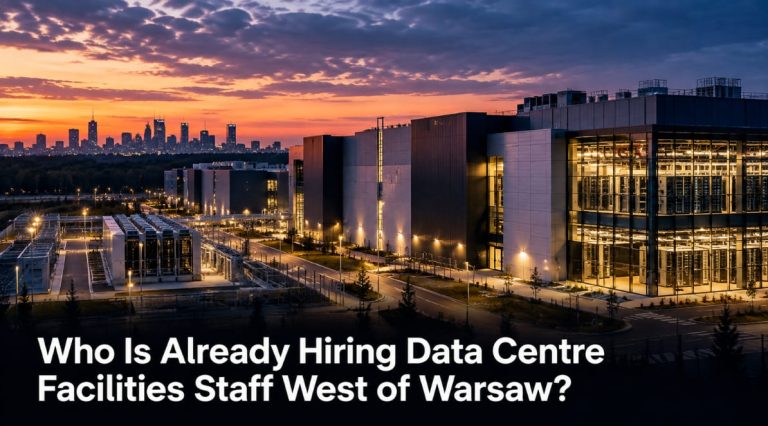
Microsoft has been in Poland for more than three decades, but its biggest Polish bet is not the sales office. It is the data-centre campuses on the edge of Warsaw.
The company arrived in 1992 as a commercial business: sales, marketing, services and a partner network built around Windows, Office and, later, Azure. That business still exists. What has changed is where the centre of gravity sits. Since 2020 Microsoft has been building physical infrastructure in Poland, and in 2026 that infrastructure, not the country office, is the reason working at Microsoft in Poland is worth a closer look.
For anyone weighing up working at Microsoft in Poland, three questions matter. What does it pay, what is the work, and what do the people who work there actually say. Here is the picture in 2026.

What Does Microsoft Do in Poland?
Microsoft in Poland is really two things at once.
The first is the commercial subsidiary.
Microsoft has operated in the country since 1992, based in Warsaw, running sales, marketing, customer and partner services, and a smaller set of technical and engineering roles that support customers across Central and Eastern Europe. This is the classic Microsoft country operation, and for years it was the whole story.
The second is infrastructure.
In May 2020 Microsoft announced a one billion dollar Polish Digital Valley plan, its largest single commitment in the country at the time, anchored by a promise to build a local data-centre region. That region, Poland Central, opened near Warsaw in April 2023 as the first hyperscale Azure region in Central and Eastern Europe, spread across three physical locations and three availability zones.
How this Shift Changed Microsoft Jobs in Poland
That shift changed what jobs Microsoft started recruiting for.
Alongside the commercial and engineering roles, Microsoft now hires for data-centre operations in the Warsaw area: site and campus management, critical environment and facilities engineering, mechanical and electrical roles, IT operations and physical security, plus the construction trades that build the campuses in the first place.
Microsoft publishes two different Poland numbers, and they should not be added together. A March 2026 company briefing said it employs more than 450 people in the country and works with about 8,400 partner firms. That is the commercial subsidiary. A 2024 fact sheet on the campuses put 39 people on the facilities, projected 64 full-time staff and contractors by the end of 2026, and more than 515 jobs at peak construction. The first figure is the office. The second is the sites.
One distinction is worth drawing. Microsoft does not run a single, several-thousand-strong services hub in Poland the way Citi or Google do. Its Polish footprint is a commercial subsidiary sitting on top of a fast-expanding hyperscale infrastructure operation. That makes the roles more varied, and, for the infrastructure side, closer to Poland’s wider data-centre workforce than to a conventional corporate back office.
What Does Microsoft Pay in Poland?
For software and engineering roles, Microsoft pays at the top of the Polish market, alongside Google and above most banks.
On Levels.fyi, self-reported total software-engineering packages in the Warsaw area run from roughly PLN 291,000 at level 62 to about PLN 651,000 at level 65, with a median near PLN 531,000. A level 63 engineer sits around PLN 360,000. A level 64 engineer, a common mid-to-senior band, sits around PLN 541,000. Software-engineering managers report a median close to PLN 512,000, with the highest submitted packages above PLN 760,000.
These figures are self-reported, drawn from a modest sample, and move with team, level and year, so treat them as a guide rather than a quote. They are also not a clean like-for-like against Google’s Warsaw median: the two companies start their published ladders at different grades. For the wider market context, Verita HR’s full salary guide is available here.
The infrastructure roles are a different market. Data-centre operations, critical environment and facilities positions benchmark against the trades and engineering market rather than software compensation, so those packages look nothing like the Levels.fyi engineering numbers.
Microsoft’s own published Poland bands for data-centre technicians run from PLN 98,200 to PLN 138,000 at ATR-B and PLN 121,700 to PLN 175,400 at ATR-C. That sits in the same range as the wider Warsaw technician market set out in Verita HR’s data-centre workforce briefing. For employers, the split is the whole point: staffing a Microsoft-scale site means competing on two very different pay curves at once.
These figures are Warsaw-area software-engineering packages and published technician bands, not commercial or sales roles.
What the Reviews Say
Employees in Warsaw rate Microsoft at about 4.4 out of 5 on Glassdoor, with roughly 97% saying they would recommend it to a friend. Those headline numbers look stronger than the company-wide score of about 4.0, with roughly three-quarters recommending Microsoft globally. They also rest on a small local sample: around 40 Warsaw reviews, not the hundreds behind the Citi or Google Poland figures. Treat the percentage as a snapshot, not a census.

The qualitative picture is more stable than the percentages. Reviewers point to the obvious strengths of a top-tier technology employer: the brand on a CV, genuine learning and development, strong benefits, and the chance to work on cloud and AI at hyperscale.
The criticisms track Microsoft’s global picture more than anything uniquely Polish. Reviewers mention internal politics and a competitive culture, reorganisation and layoff noise across the company in 2026, and a sense in some teams that pay has not kept pace with workload. None of that is unusual for a company of Microsoft’s size, but it is worth weighing against the brand.
The Polish Glassdoor sample is small and dominated by Warsaw-based staff. Sub-scores move quickly on a sample this size and are not repeated here.
Who It Suits
Working at Microsoft in Poland suits two fairly different people. The first is the cloud, AI or cybersecurity specialist who wants a globally recognised employer and pay at the top of the local market. The second is the infrastructure professional (a data-centre operations lead, a critical-environment engineer, a facilities or electrical specialist) who wants to work on hyperscale infrastructure at the point where Poland is building the most.
It suits less well anyone looking for a large, established local engineering hub with thousands of peers in one building. That is Google’s shape in Poland, not Microsoft’s. Microsoft’s Polish story is younger, more infrastructure-led, and still being built.
What Is Happening Now at Microsoft Poland
The headline remains the build-out, even though the last announced spending window has now closed.
In February 2025 Microsoft announced a further PLN 2.8 billion, about 700 million dollars, which it said it would spend by June 2026 on expanding its Polish data-centre campuses and bringing more Azure services online. The same announcement set out a cybersecurity framework with Poland’s Ministry of National Defence. As of publication in September 2026, Microsoft has not issued a public statement confirming that the June 2026 spend is complete.
The skills pledge needs the same care. Microsoft said it would help skill one million Polish workers in AI and digital skills by the end of 2025, on top of the 430,000 trained between 2020 and 2023. By July 2025 the company reported that 500,000 people in Poland had engaged in AI learning and described that as the halfway point of the pledge. A later public confirmation that the million was reached has not been issued.
Announcing the investment in Warsaw alongside Prime Minister Donald Tusk, Microsoft Vice Chair and President Brad Smith posted on X:
Tusk called it “an investment in our future, our security, our youth, our startups, and our scholars.”
For anyone thinking about working at Microsoft in Poland, that is the context. The money has been aimed at cloud, AI infrastructure and cybersecurity. The hiring that follows is still split between a relatively small commercial and engineering office and a growing set of operational roles on the campuses themselves.
How Verita HR Can Help
For any company hiring against a name like Microsoft, the case for working with a specialist recruiter is getting stronger by the quarter. The employers building and staffing Poland’s cloud and data-centre capacity are chasing the same shortlist: cloud and AI engineers, the specialists closing Poland’s AI gap, cybersecurity professionals, and the data-centre operations and facilities talent that hyperscale sites depend on.
That is what working at Microsoft in Poland really looks like in 2026, and for employers competing for the same talent, Verita HR can help.
Author: Grace Sharp
See Also:
Working at Google in Poland: Salary, Reviews and Culture (2026)
Working at Citi in Poland: Salary, Reviews and Culture (2026)
Poland’s Data Centre Workforce: Jobs, Salaries and the Real Impact (2026)